Treasury Eases Russia Oil Sanctions as Bitcoin Holds $72K
The U.S. Treasury Department issued a 30-day sanctions waiver on Russian oil shipments Thursday, aiming to cool global energy prices above $100 a barrel, while Bitcoin held firm at $72,320 and the network’s hashrate remained near all-time highs at 930 EH/s.
WHAT TO KNOW
- OFAC General License 134 authorizes the delivery and sale of Russian crude loaded on vessels as of March 12, 2026, valid through April 11.
- Russia continues using Bitcoin and stablecoins to settle oil trades with China and India, processing tens of millions of dollars monthly in crypto conversions.
OFAC Issues 30-Day Window for Stranded Russian Crude
The Office of Foreign Assets Control published General License 134 on March 12, authorizing countries to purchase Russian crude oil and petroleum products already loaded on tankers. The license expires at 00:01 EST on April 11, 2026.
Treasury Secretary Scott Bessent described the measure as “narrowly tailored” and “short-term,” designed to “increase the global reach of existing supply” without providing Russia “significant financial benefit.” The move follows GL 133, issued March 5, which specifically authorized Indian refineries to buy Russian crude already at sea.
Russia’s presidential envoy Kirill Dmitriev estimated the waiver covers roughly 100 million barrels of stranded crude, approximately one day’s worth of global output. The license comes as Iran’s supreme leader Mojtaba Khamenei threatened to block the Strait of Hormuz, sending Brent above $100 on March 12.
Bloomberg energy correspondent Javier Blas was among the first to report the initial India-specific waiver:
BREAKING: US Treasury eases oil sanctions on the Kremlin, allowing Indian refineries to buy the millions of barrels of Russian crude on floating storage until early April (the new rules cover all the oil already loaded in a tanker by March 5, 2026). Massive win for Putin. https://t.co/qyD9zWe7hC pic.twitter.com/OOLriVsOV8
— Javier Blas (@JavierBlas) March 6, 2026
Source: @JavierBlas on X
GL 134 expanded the scope from India-only to any country willing to purchase the stranded cargo.
Oil Drops Below $100 but Remains Elevated
Brent crude fell 71 cents to $99.75 per barrel in early Friday trading, while West Texas Intermediate dropped 88 cents to $94.85. Both benchmarks had surged above $100 on March 12 following escalated Persian Gulf tensions.
The waiver’s effect was muted. Prices remain well above the $60-per-barrel cap Western nations imposed on Russian seaborne crude in December 2022, suggesting that Hormuz-driven supply fears continue to dominate the market.
Russia’s Growing Use of Bitcoin in Oil Settlements
The sanctions waiver arrives against a backdrop of Russia’s expanding use of cryptocurrency to circumvent Western financial restrictions. Russian oil companies have been using Bitcoin, Ether, and Tether to convert yuan and rupee oil payments into rubles, with crypto-facilitated oil settlements reaching tens of millions of dollars per month.
A 30-day sanctions window may temporarily reduce Moscow’s incentive to route trades through crypto rails, since conventional payment channels briefly become available for the stranded cargoes. But the structural trend is accelerating. Russia’s Central Bank is studying a ruble-pegged stablecoin for cross-border trade, with legislation expected by mid-2026.
The Chainalysis sanctions evasion report noted that over 70% of Russia’s crypto trade volume involves Tether, with total daily crypto-based foreign trade settlements reaching approximately 50 billion rubles.
Bitcoin Network Health Contrasts With Extreme Fear Sentiment
Bitcoin traded at $72,320 at press time, up 2.31% over 24 hours, with daily trading volume at $50.13 billion. The price has held above the $70,000 psychological support despite weeks of geopolitical uncertainty.
ON-CHAIN DATA
- Hashrate: 930.1 EH/s
- Difficulty: 145.04 T (current epoch)
- Mempool fees: 1-2 sat/vB (near historic lows)
- 24h transactions: 418,100
- Market cap: $1.45 trillion
The network’s fundamentals paint a different picture than market sentiment. The Fear and Greed Index sits at 15, deep in Extreme Fear territory, down from 18 a week ago and its lowest monthly reading of 11.
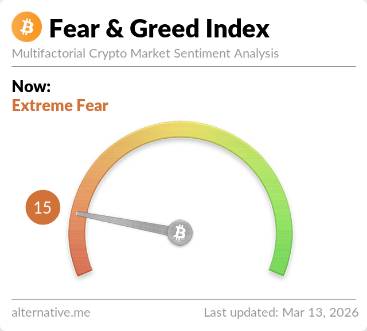
Yet hashrate at 930 EH/s signals miners remain committed. Mempool fees at 1-2 sat/vB indicate the network is processing transactions efficiently with no congestion, even as post-halving mining economics squeeze margins.
Energy Prices, Inflation, and Bitcoin’s Macro Position
Elevated oil prices feed directly into inflation expectations, which have historically pressured risk assets including Bitcoin. Brent above $100 increases input costs across the global economy, complicating any Federal Reserve pivot toward rate cuts.
However, the sanctions relief also highlights a structural shift. Each time Western nations toggle sanctions on or off, it reinforces the value proposition of a neutral settlement layer that no single government controls. Bitcoin and stablecoins are already filling that gap in Russia’s oil trade.
U.S. spot Bitcoin ETFs have continued absorbing capital through the turbulence, with $115 million in net inflows logged on a recent triple-asset inflow day, suggesting institutional conviction has not wavered despite the Extreme Fear reading.
Outlook: GL 134 Expires April 11 as Energy Risks Persist
The 30-day waiver creates a narrow window. If Strait of Hormuz tensions escalate further before April 11, the Treasury may face pressure to extend GL 134 or expand its scope. Each extension would effectively loosen the sanctions regime that pushed Russia toward crypto settlements in the first place.
For Bitcoin, the network’s fundamentals remain robust regardless of geopolitical shifts. Difficulty at 145.04 T reflects sustained miner investment. The next difficulty adjustment will recalibrate based on the current 930 EH/s hashrate, and Russia’s own mining sector, though constrained by regional bans citing 3,000 MW power shortages, continues to operate in unrestricted zones.
The intersection of energy geopolitics and Bitcoin’s role as a settlement layer is no longer theoretical. It is happening in real-time across Russian oil terminals, Chinese yuan conversion desks, and Indian refinery payments.
Disclaimer: This article is for informational purposes only and does not constitute financial advice. Cryptocurrency investments carry significant risk. Always conduct your own research before making investment decisions.