
Economists Predict Two Fed Rate Cuts as Warsh Faces ‘Perfect Storm’
Bitcoin holds above $72,000 as a CNBC Fed Survey reveals economists expect only two more quarter-point rate cuts in 2026, a pace that keeps real rates elevated and risk-asset liquidity constrained. Incoming Federal Reserve Chair Kevin Warsh inherits a divided committee, sticky inflation and a labor market that showed cracks in February’s 92,000 payroll contraction.
WHAT TO KNOW
- The CNBC Fed Survey forecasts two 25-basis-point cuts in 2026, bringing the funds rate to roughly 3%. CME FedWatch prices a 96% probability of no change at the March 18 meeting.
- Bitcoin trades at $72,257 with the Fear & Greed Index at 15 (Extreme Fear), while network hashrate sits near 908 EH/s and transaction fees hold at 1 sat/vB.
CNBC Survey: Only 50 Basis Points of Cuts Expected This Year
The January CNBC Fed Survey projects the federal funds rate settling near 3% by year-end, with no further reductions expected through 2027. The forecast mirrors fed funds futures pricing, where neither Wall Street nor economists believe a Trump-appointed chair will drive overnight rates toward the 1% level the president has demanded.
Improving growth expectations underpin the firmer outlook. Survey respondents project 2.4% GDP growth in 2026 and 2.2% in 2027, both above the Fed’s estimated potential growth rate. The consumer price index is forecast at 2.7% by December, declining to 2.5% in 2027.
Recession probability fell to 23%, down from 30% in December and a peak of 53% in May 2025 during the “liberation day” tariff shock. “We anticipate continued solid and more consistent economic growth in 2026, underpinned by fiscal stimulus and easier monetary policy,” Kathy Bostjancic, chief U.S. economist at Nationwide, wrote in her survey response.
Warsh Confronts Divided FOMC and Macro Headwinds
Kevin Warsh, whom 50% of survey respondents expect Trump to name as Fed chair, faces what Troy Ludtka, senior U.S. economist at SMBC Nikko Securities, called a “perfect storm” of stagflationary pressures when he assumes office in May.
The Federal Open Market Committee is already split over policy direction. Several officials, including Fed Governor Michael Barr and Cleveland Fed President Beth Hammack, have publicly rejected Warsh’s argument that AI-driven productivity gains justify lower rates. CME FedWatch data shows markets assign just a 5.9% probability of a cut at the March 18 meeting, with June cut odds at 46.8%.
Warsh’s hawkish track record during the 2007-2009 financial crisis adds to uncertainty. In September 2008, he stated: “I’m still not ready to relinquish my concerns on the inflation front.” Renaissance Macro Research noted: “Kevin Warsh has been a monetary policy hawk his entire career. His dovishness today stems from convenience.”
Policy uncertainty itself acts as a brake on growth. “Policy uncertainty acts as a tax on the economy. It causes paralysis,” said Diane Swonk, chief economist at KPMG.
Rate Outlook Keeps Pressure on Bitcoin Liquidity
For Bitcoin, the constrained rate-cut path limits the dollar liquidity expansion that historically fuels risk-asset rallies. Bitcoin traded at $72,257 at press time, up 2.5% over 24 hours, with a market capitalization of $1.446 trillion and daily trading volume of $50.07 billion.
Markus Thielen of 10x Research framed the Warsh scenario as directionally bearish: “Markets generally view a resurgence of Warsh’s influence as bearish for Bitcoin, as his emphasis on monetary discipline, higher real rates, and reduced liquidity frames crypto not as a hedge against debasement but as a speculative excess that fades when easy money is withdrawn.”
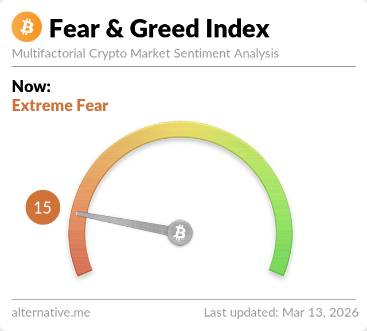
The Fear & Greed Index has sat in Extreme Fear territory for the past month, dropping from 18 last week to 15 today. The last comparable stretch of sub-20 readings occurred in June 2022, during the Terra-LUNA collapse.
Spot Bitcoin ETFs have offered a partial counterweight. U.S.-listed funds absorbed $115 million in a single session earlier this week, though flows remain well below the $700 million daily peaks seen in late 2025.
Bitcoin Network Fundamentals Hold Steady
Despite macro headwinds, Bitcoin’s on-chain metrics reflect a healthy network. Hashrate sits near 908 EH/s with mining difficulty at 145 trillion, both near all-time highs. The network processed roughly 409,500 transactions at an average block time of 10.8 minutes.
ON-CHAIN DATA
- Hashrate: ~908 EH/s (near all-time high)
- Difficulty: 145.04 trillion
- Median fee: 1 sat/vB across all priority tiers
- 24h estimated tx volume: $6.48 billion
Transaction fees at 1 sat/vB across all priority tiers signal low mempool congestion, a pattern that typically aligns with reduced speculative activity. This fee environment lowers the cost of on-chain settlement but also reflects diminished urgency among market participants navigating macro uncertainty.
Mining economics remain under pressure from the April 2024 halving. Post-halving break-even costs continue to climb as AI data centers compete for energy capacity, though the elevated hashrate suggests miners remain profitable at current prices.
Outlook: March FOMC and Warsh Confirmation in Focus
The March 18 FOMC meeting will provide the next policy signal, with markets overwhelmingly pricing a hold. Warsh’s Senate confirmation process, expected to intensify in coming weeks, will shape expectations for the second half of 2026.
The survey’s 44% preference for Fed Governor Chris Waller over Warsh indicates economist skepticism about the incoming chair’s policy approach. If Warsh adopts a more accommodative stance than his record suggests, the shift could unlock dollar liquidity that Bitcoin has historically captured. If he defaults to hawkish form, the current Extreme Fear sentiment may deepen.
Bitcoin’s relationship with Fed policy has tightened since institutional adoption accelerated via ETFs. The next difficulty adjustment, due in roughly 12 days, and the March FOMC statement will test whether on-chain fundamentals can sustain current price levels against a restrictive monetary backdrop.
Disclaimer: This article is for informational purposes only and does not constitute financial advice. Cryptocurrency investments carry significant risk. Always conduct your own research before making investment decisions.