
US Opens $10T Retirement Market to Crypto: Can Bitcoin Benefit?
The U.S. Department of Labor proposed a rule on March 30, 2026, that would expand how 401(k) fiduciaries evaluate alternative investments, including crypto. The move affects more than 90 million Americans in employer-sponsored retirement plans, but whether Bitcoin stands to gain meaningful inflows depends on adoption realities that the headline figure obscures.
WHAT TO KNOW
- The trigger: The DOL’s March 30 proposal creates process-based safe harbors for fiduciaries adding alternative assets, including crypto, to 401(k) menus.
- The pace: Retirement capital moves through layers of plan-sponsor approval, compliance review, and participant opt-in, so any crypto allocation will unfold over quarters or years, not days.
What Changed in the US Retirement Market for Crypto?
The DOL’s proposed rule would let plan fiduciaries evaluate a broader set of designated investment alternatives under a new safe-harbor framework, according to the agency’s official release. The department said the change could increase potential retirement investment options for more than 90 million Americans.
This proposal did not appear in a vacuum. On May 28, 2025, the DOL rescinded its 2022 guidance that had told fiduciaries to exercise “extreme care” before adding crypto to 401(k) plans. The agency acknowledged the prior standard was not found in ERISA. Then, on August 7, 2025, the White House issued an executive order titled “Democratizing Access to Alternative Assets for 401(k) Investors,” directing the DOL, Treasury, and the SEC to revisit the framework.
The March 30 action is the proposal stage of that process, not a final rule. A public comment period will follow before anything takes effect. Many headlines compress these three distinct steps into a single “market opened” event, which overstates where things stand today.
The “$10T” figure circulating in coverage is a rough shorthand. According to ICI’s 2025 Fact Book, 401(k) plans held $8.9 trillion in assets at year-end 2024, while total defined-contribution plans held $12.4 trillion. Neither number matches the round headline figure exactly.
How Bitcoin Could Benefit if Retirement Capital Reaches Crypto
Bitcoin is the most likely first destination for any new retirement-plan crypto allocation. It has the deepest liquidity, the longest track record among digital assets, and a growing ecosystem of regulated investment vehicles such as spot ETFs. Plan sponsors seeking to add crypto exposure with the least friction would almost certainly start with BTC.
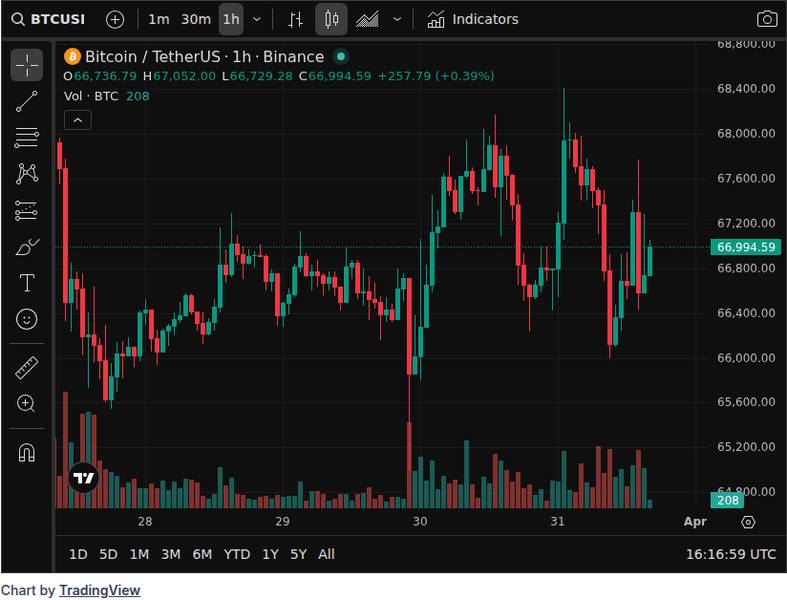
At the time of writing, BTC traded at $66,862 with a market cap near $1.34 trillion and 24-hour volume of roughly $52.2 billion. The price had dipped about 0.8% over the prior 24 hours, and the Fear and Greed Index sat at 11, deep in “Extreme Fear” territory.
The potential benefits extend beyond direct buying. Even if only a small fraction of plan sponsors add crypto menus, the legitimacy signal could boost institutional sentiment around Bitcoin. It could also increase demand for regulated custody and fund products, similar to how Interactive Brokers’ expansion of crypto trading into Europe widened access without immediately moving prices.
Bitcoin is not the only possible destination. Some plans could offer diversified crypto index funds or exposure to stablecoins, which have seen growing institutional use in areas like DeFi lending yields and stablecoin-based payment infrastructure. Still, BTC’s dominance at 56.07% makes it the default benchmark for any broad crypto allocation.
Why the $10T Figure Does Not Automatically Translate Into Bitcoin Demand
The GAO identified just 69 crypto asset investment options available to 401(k) participants in its review, and noted that crypto assets remain a small part of the 401(k) market. Policy access and actual adoption are separated by multiple gatekeepers.
Plan sponsors, not individual participants, decide what appears on a 401(k) menu. Each sponsor must evaluate fiduciary risk, select a provider, negotiate fees, and often secure board or committee approval. Even with safe-harbor protections, most large employers will move cautiously, particularly given Bitcoin’s volatility profile relative to traditional retirement assets.

Allocation caps add another constraint. Plan sponsors that do add crypto are likely to set maximum allocation limits, perhaps 1% to 5% of a participant’s portfolio. Even if every 401(k) dollar were eligible, a 1% allocation across $8.9 trillion would mean roughly $89 billion, and the actual adoption rate will be far below 100%.
No direct evidence yet ties the March 30, 2026, DOL proposal to measurable BTC inflows, retirement-plan allocations, or on-chain accumulation. The proposal must still survive the comment period and finalization before it carries regulatory weight.
The retirement market opening is real, but it is a doorway, not a floodgate. Bitcoin’s position as the most likely first-choice crypto asset in retirement portfolios gives it a structural advantage. Whether that advantage converts into material demand depends on how quickly plan sponsors move through the compliance process, and that timeline is measured in quarters, not headlines.
Disclaimer: This article is for informational purposes only and does not constitute financial or investment advice. Cryptocurrency and digital asset markets carry significant risk. Always do your own research before making decisions.