
Ripple Partners With Ex-Western Union Unit To Streamline Cross-Border Payments: Is XRP Set for a Breakout?
Ripple and cross-border payments network Thunes have expanded their partnership to broaden payout coverage across key global markets, building on a collaboration that dates back to 2020. Some crypto outlets have described Thunes as an “ex-Western Union unit,” though no authoritative source confirms that characterization.
The expanded arrangement, announced on September 2, 2025, aims to improve the payout experience for Ripple Payments clients by tapping into Thunes’ Direct Global Network. The companies said the deal will streamline global money movement and extend coverage in corridors where real-time settlement demand is growing.
What Ripple’s Partnership With Thunes Actually Signals
Ripple Payments says it now covers 90+ payout markets, representing more than 90% of daily foreign exchange markets, and has processed more than $70 billion in total volume. Thunes brings its own scale: real-time payments in over 130 countries, more than 80 currencies, connections to over 7 billion wallets and bank accounts, plus 15 billion cards through 320+ payment methods.
The deal matters because cross-border payments remain Ripple’s core commercial use case. While the company has expanded into custody and stablecoins, its payments network is the revenue engine that enterprise clients evaluate. Adding Thunes’ reach gives Ripple Payments a wider last-mile distribution layer without building those local rails from scratch.
Some headlines have framed Thunes as a former Western Union unit, but according to unconfirmed reports, no authoritative source supports that claim. Thunes’ own archive shows the company partnered with Western Union in 2019 to expand mobile-wallet payouts, a relationship between two independent firms rather than a corporate spinoff. The distinction matters: Thunes operates as an independent payment infrastructure company, not a legacy remittance brand shedding a subsidiary.
Thunes has also built relationships beyond Ripple. In November 2025, Mastercard partnered with Thunes on stablecoin wallet payouts, signaling that the network is positioning itself as a multi-rail distribution layer rather than an exclusive conduit for any single payments provider. For Ripple, this means the partnership adds real infrastructure value, but does not lock out competitors from the same corridors. As the U.S. opens broader financial channels to crypto, infrastructure partnerships like these become more strategically important.
Why Cross-Border Payments Could Put XRP Back in the Spotlight
Investors have long drawn a direct line between Ripple’s business traction and XRP’s market performance. The logic is straightforward: if Ripple Payments grows its enterprise footprint, demand for XRP as a bridge asset could follow, even though Ripple’s institutional product does not require clients to hold or trade XRP directly.
At the time of writing, XRP traded at $1.34, up 1.54% over 24 hours, with an approximately $82.46 billion market cap and roughly $2.20 billion in daily trading volume.
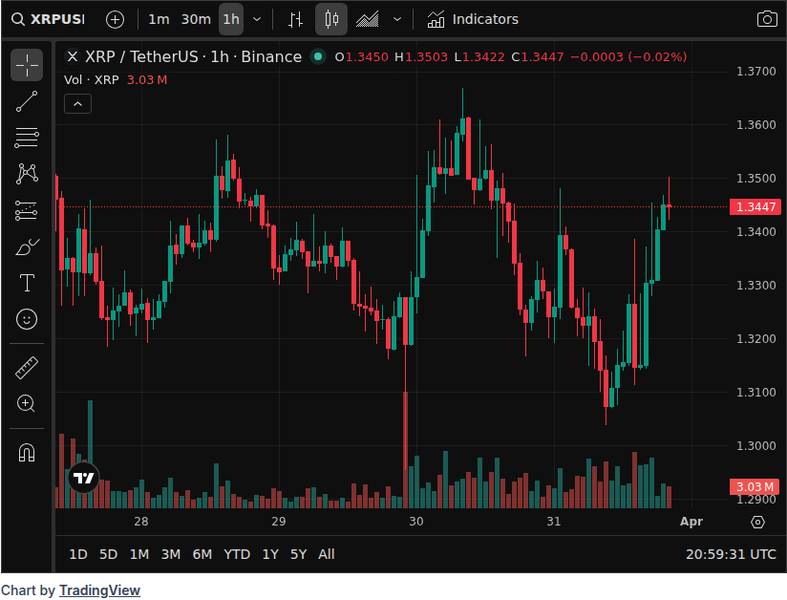
Those numbers sit well below XRP’s all-time high of $3.65, reached on July 18, 2025, leaving the token about 63% below that peak. Meanwhile, the broader crypto market is deep in risk-off territory: the Fear & Greed Index reads 11 out of 100, firmly in “Extreme Fear.” That backdrop makes it difficult for any single partnership headline to drive sustained upside, regardless of its strategic merit.
The pattern is familiar. Ripple partnership announcements have historically triggered short-term XRP rallies that fade once the initial attention cycle passes. The separation between Ripple’s enterprise business and XRP’s spot market performance is real, even if investor sentiment tends to blur the two. As crypto trading access expands into new markets, XRP’s liquidity profile could benefit from broader retail participation, but that is a structural trend rather than a catalyst tied to any single deal.
Is This Enough To Support a Real XRP Breakout Narrative?
The Thunes expansion is a legitimate infrastructure win for Ripple Payments. It extends payout reach, adds credibility with enterprise buyers, and reinforces Ripple’s positioning as a serious cross-border payments provider. None of that is trivial.
But labeling it a “breakout moment” for XRP overstates what the evidence supports. No verified expert analysis or research note has tied this specific partnership to a sustained XRP price move. The current market environment, with Extreme Fear sentiment at 11/100, is not one where partnership headlines alone shift momentum. Even the DeFi yield landscape reflects caution, with capital rotating toward stable returns rather than speculative exposure.
What the partnership does confirm is that Ripple continues to build commercial infrastructure at scale. Covering 90+ payout markets and processing more than $70 billion positions the company as a credible alternative to legacy remittance rails. Whether that translates into XRP demand depends on factors the partnership alone cannot control: regulatory clarity, on-demand liquidity adoption by Ripple clients, and broader market recovery.
For XRP holders watching the Thunes headline, the takeaway is measured. The deal strengthens Ripple’s enterprise story without changing XRP’s immediate supply-demand dynamics. A breakout requires more than a single partnership, no matter how well-positioned the partner.
Disclaimer: This article is for informational purposes only and does not constitute financial or investment advice. Cryptocurrency and digital asset markets carry significant risk. Always do your own research before making decisions.