
Bitcoin ETF Multiplier Effect: Cory Klippsten’s BTC Case
Swan Bitcoin CEO Cory Klippsten argues that spot Bitcoin ETFs will drive demand for BTC far beyond the funds themselves, a thesis he calls the “ETF multiplier effect.” With BlackRock’s IBIT alone holding over $53 billion in net assets and Bitcoin trading near $67,010, the structural case for broader adoption is gaining traction, but the headline-grabbing claim that Bitcoin could still 10-20x lacks a sourced model or timeframe.
What Cory Klippsten Means by the ETF Multiplier Effect
In a February 1, 2024 interview with Cointelegraph, Klippsten laid out a simple argument: the approval of spot Bitcoin ETFs in the United States would not just channel money into the funds. It would legitimize Bitcoin across an entirely new layer of institutional and retail participants, triggering additional buying outside the ETF wrappers.
“A lot more Bitcoin will be purchased through all the other sellers around the world.”
— Cory Klippsten, CEO of Swan Bitcoin, via Cointelegraph
The catalyst behind the thesis is concrete. On January 10, 2024, the SEC approved the listing and trading of spot Bitcoin ETP shares, creating the regulated wrapper that institutional allocators had waited for. Chair Gary Gensler stressed at the time that the approval did not amount to an endorsement of Bitcoin itself.
Klippsten’s argument goes a step further than simple fund inflows. The multiplier effect, in plain terms, means that ETF marketing budgets, financial adviser education, and the credibility signal of firms like BlackRock backing Bitcoin would push demand through every channel, not just ETF purchases. The regulated access point acts as a gateway drug for broader adoption.
What the Bitcoin ETF Data Actually Supports
Early adoption numbers backed the thesis directionally. By February 6, 2024, the eleven U.S. spot Bitcoin ETFs had accumulated $31.2 billion in total trading volume and more than $1.6 billion in net inflows, even as Grayscale’s GBTC saw $6.1 billion in outflows during the same period.
The scale has only grown since. BlackRock’s iShares Bitcoin Trust ETF, which launched on January 5, 2024, held $53.27 billion in net assets as of March 9, 2026. A single fund accumulating that level of Bitcoin exposure in roughly two years is without precedent in crypto product history.
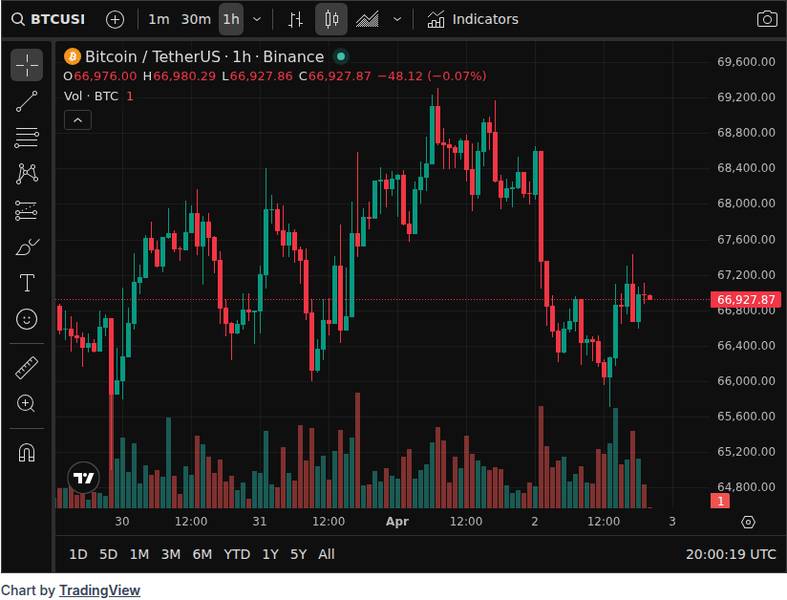
Bitcoin itself traded at $67,010 with a market capitalization of roughly $1.34 trillion on April 2, 2026, while 24-hour trading volume sat near $48.1 billion. The price has moved well above the levels seen at ETF launch, though the path has been anything but linear.
The supply side adds context. Bitcoin’s circulating supply stands at roughly 20.01 million out of a hard cap of 21 million coins. As ETF-driven institutional demand competes for an asset with a fixed and diminishing issuance schedule, basic supply-demand dynamics suggest upward price pressure, though the magnitude and timing remain unknowable.
That scarcity argument is what makes the multiplier thesis structurally interesting. If ETFs pull new capital into a market where regulatory clarity is still evolving, the effect on price could be disproportionate to the inflow size itself. It is a demand-shock thesis applied to a supply-constrained asset.
Why the 10-20x Claim Still Needs Proof
The verified part of this story is narrow: Klippsten made a credible structural argument about how ETF approval expands Bitcoin demand beyond direct fund flows. The unverified part is the headline number. According to the original aggregator headline, Bitcoin could still 10-20x from current levels, but no fetched primary transcript, presentation, or research note quantifies that specific projection or provides a timeframe.
A 10x move from $67,010 would put Bitcoin near $670,000, implying a market cap above $13 trillion. A 20x move would mean roughly $1.34 million per coin. For context, that upper bound would make Bitcoin’s market capitalization larger than any single asset class outside of the total global equity market.
To support such a projection credibly, an analyst would need to show adoption curve assumptions, a timeline, capital inflow models, and sensitivity to macroeconomic variables like interest rates and market liquidity conditions. None of that appeared in the sourced material.

Short-term sentiment adds another wrinkle. The Fear & Greed Index read 12, deep in “Extreme Fear” territory, on the same day these figures were pulled. That risk-off mood contrasts sharply with any long-term bullish multiplier thesis, and it is a reminder that structural arguments operate on a different clock than market psychology.
The ETF multiplier effect is a real and observable phenomenon: regulated access has expanded Bitcoin’s buyer base, and the data confirms it. What the data does not confirm is how far that effect can carry the price. Investors watching for signs of sustained institutional accumulation, particularly through products like IBIT, may find more clarity as enforcement actions and regulatory frameworks continue to shape the market’s risk profile in 2026.
Disclaimer: This article is for informational purposes only and does not constitute financial or investment advice. Cryptocurrency and digital asset markets carry significant risk. Always do your own research before making decisions.