
Lucky Independent Bitcoin Miner Nets $210,000 BTC Reward
A solo Bitcoin miner running roughly 230 terahashes per second beat extraordinary odds on April 2, successfully mining block 943411 and collecting a gross reward of 3.13904392 BTC, worth approximately $210,000 at the time of confirmation.
The miner used Solo CK, an anonymous solo-mining service operated by developer Dr -ck, rather than joining a traditional mining pool. After Solo CK’s published 2% service fee, the miner’s address received 3.07626305 BTC directly, while a separate output of 0.06278087 BTC went to the service.
Independent Bitcoin Miner Lands a Rare Block Reward
Block 943411 was confirmed at 21:02:41 UTC on April 2, 2026 and contained 3,961 transactions. The block’s coinbase transaction paid out a total of 313,904,392 satoshis, combining the 3.125 BTC subsidy with transaction fees collected from those transactions.
WHAT TO KNOW
- The win: A solo miner with ~230 TH/s mined Bitcoin block 943411 via Solo CK, earning a gross reward of 3.13904392 BTC (roughly $210,000).
- The odds: CKPool operator Dr -ck estimated the miner had a 1-in-28,000 chance per day of solving a block at that hashrate.
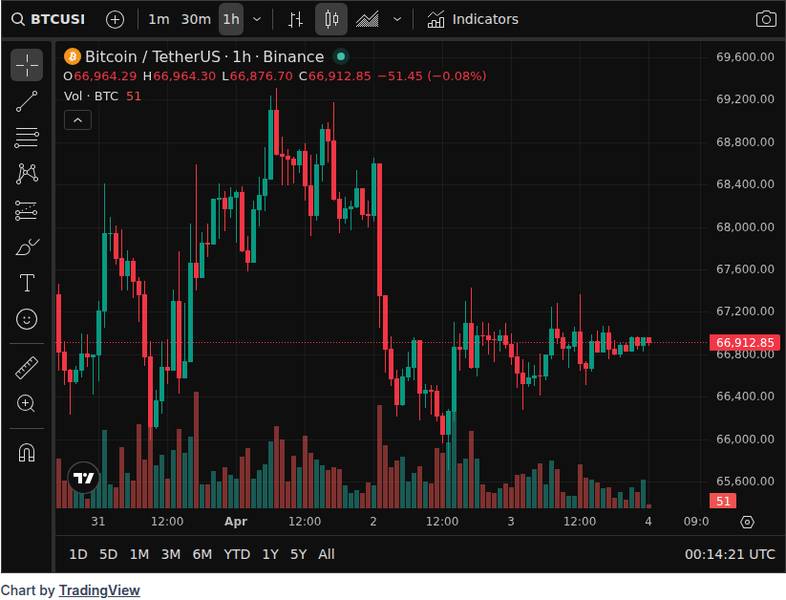
With Bitcoin trading near $66,899 at the time of confirmation, the gross block reward translated to roughly $209,999. The miner’s net take, after Solo CK’s 2% cut, came to about $205,800, a distinction many initial reports glossed over.
Dr -ck confirmed the win on X, identifying the miner’s address and noting this was the 312th solo block found through the Solo CK service.
Congratulations to miner bc1qtt7cr9cxykyp9g4hq47zf5lq9t97cxvq72lun3 with ~230TH for solving the 312th solo block at https://t.co/UWgBvLk5AE!
A miner of this size has a 1 in ~28k chance per day of solving a block.https://t.co/dx3lUuDRbl pic.twitter.com/uiDOzZdHts
— Dr -ck (@ckpooldev) April 2, 2026
Source: @ckpooldev on X
Network difficulty at the time of the block stood at 133,793,147,307,542.75, underscoring just how computationally unlikely it was for a miner of this size to find a valid hash before massive pool operators.
Why This Solo Mining Win Matters for Bitcoin Watchers
At 230 TH/s, the winning miner controlled a negligible fraction of Bitcoin’s total network hashrate. For context, large mining pools collectively operate in the hundreds of exahashes, meaning this miner was outgunned by a factor of roughly a million. The 1-in-28,000 daily odds Dr -ck cited make the win comparable to hitting a long-shot sports bet, except the payout came directly from Bitcoin’s protocol.
The event arrives during a period of broad market unease. The Fear and Greed Index sat at 11 at the time, deep in “Extreme Fear” territory, as Bitcoin came off its worst quarter since 2018. Against that backdrop, a six-figure windfall for a small operator made for a sharply contrasting narrative.
Solo mining wins also serve as a practical reminder of how Bitcoin’s incentive design works. The protocol does not care about a miner’s size; anyone contributing valid proof-of-work has a probability-weighted shot at the full block reward. That principle is foundational to Bitcoin’s security model, even as hardware security and custody remain separate concerns for miners holding newly earned BTC.
How Independent Bitcoin Mining Compares With Pool Mining
Most miners join pools to smooth out earnings. In a pool, thousands of participants combine hashrate and split rewards proportionally, receiving small, regular payouts rather than waiting for an improbable solo win. For a miner with 230 TH/s, pool mining would yield a tiny but steady trickle of satoshis each day.
Solo CK occupies a middle ground. It provides the infrastructure of a pool, routing work to participants and handling block submission, but each miner competes independently for the full block reward. The service charges a flat 2% fee on any block found, meaning the miner keeps 98% of whatever they win but earns nothing on days they lose.
That trade-off makes solo mining a deliberate gamble. The economics favor pool mining for anyone who needs predictable revenue to cover electricity and hardware costs. But for miners willing to absorb long dry spells, a single block find can deliver a lump-sum payout far exceeding months of pooled earnings.
As institutional players like Schwab move toward spot Bitcoin trading, the mining side of Bitcoin’s ecosystem continues to produce these lottery-style outcomes. Block 943411 will not change the economics of industrial mining, but it is a concrete data point: small operators can still win, even when the odds say they almost certainly will not.
ON-CHAIN DATA
- Block: 943411 (April 2, 2026, 21:02:41 UTC)
- Gross reward: 3.13904392 BTC (~$209,999)
- Miner payout: 3.07626305 BTC to bc1qtt7cr9…72lun3
- Service fee: 0.06278087 BTC (2% to Solo CK)
- Transactions in block: 3,961
Disclaimer: This article is for informational purposes only and does not constitute financial or investment advice. Cryptocurrency and digital asset markets carry significant risk. Always do your own research before making decisions.