
Why the Fed’s Latest FedNow Proposal Could Be a Major Boost for Ripple and XRP
The Federal Reserve on April 8, 2026 proposed allowing U.S. banks and credit unions to use intermediaries when transferring funds through the FedNow Service, a policy shift that could open new cross-border payment corridors and strengthen Ripple’s positioning in the real-time settlement market.
The proposal targets a structural limitation: FedNow transfers currently require both parties to be U.S. banks. Under the new framework, intermediaries could facilitate transactions, with the Fed explicitly citing correspondent banking for international payments as a primary use case.
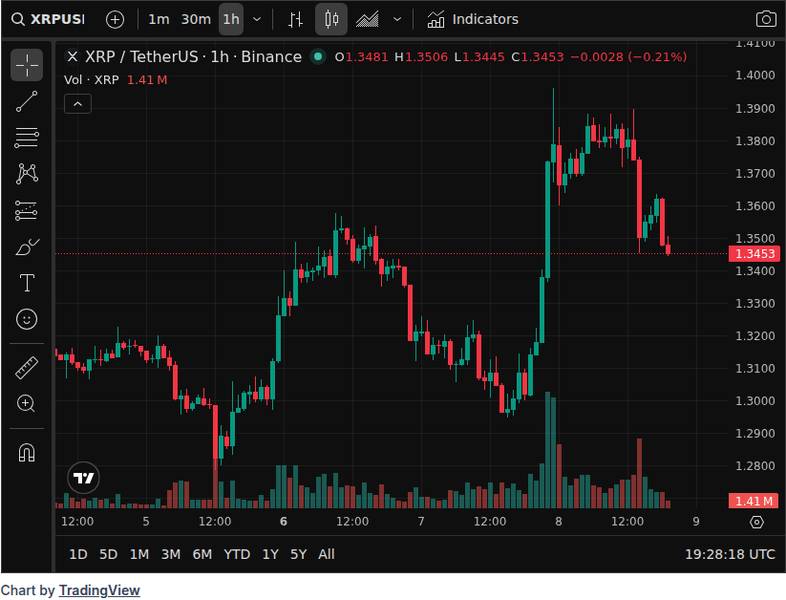
The timing aligns with several recent Ripple milestones, including its national trust bank charter going live on April 1, 2026, and a pending Fed master account application that would grant direct FedWire and FedNow access. XRP traded at $1.35 with a market capitalization of $82.75 billion at press time, up 2.98% over 24 hours.
WHAT TO KNOW
- The Fed’s FedNow intermediary proposal is in a 60-day public comment period, not yet adopted policy. Implementation timelines remain uncertain.
- Ripple’s technology underpins parts of FedNow infrastructure, but the Federal Reserve has not publicly linked this proposal to Ripple or XRP.
What the FedNow Intermediary Proposal Actually Changes
FedNow launched as a domestic instant payment rail limited to direct bank-to-bank transfers. The April 8 proposal would permit intermediaries to sit between transacting banks, enabling U.S. institutions to route payments through correspondent banks for the international leg of cross-border transactions.
This matters because cross-border payment infrastructure has been one of the slowest segments of finance to modernize. Correspondent banking networks remain fragmented, costly, and settlement times often stretch to days. A FedNow-integrated intermediary layer could compress that timeline to seconds.
The FedNow transaction limit was raised to $10 million in 2026, up from $1 million, a change that opens the service to institutional-scale cross-border flows rather than just retail payments.
Ripple was among the 57 early adopter entities selected for FedNow’s pilot program in June 2023. The company’s Interledger Protocol provides technology infrastructure for FedNow’s transaction system, giving Ripple an embedded role in the payment rail the Fed now wants to extend internationally.
How Ripple and XRP Could Benefit If the Framework Expands
Ripple the company and XRP the token occupy different positions in this landscape, and the distinction matters. Ripple builds payment infrastructure and cross-border settlement software. XRP functions as a bridge-liquidity asset in high-speed transfer use cases, but its role in any Fed-adjacent system is not confirmed.
In an optimistic scenario, Ripple’s pending Fed master account application gets approved, granting direct FedNow and FedWire access. Combined with the intermediary framework, Ripple could serve as a licensed bridge between U.S. banks and international counterparts, a role its technology already supports through existing partnerships. This pathway gained credibility when Ripple’s OCC-approved national trust bank charter went live on April 1.
The base case is more measured. Ripple continues operating as an indirect FedNow participant through banking partners while the intermediary rule undergoes its 60-day comment period and subsequent rulemaking. According to unconfirmed industry data, over 70% of FedNow service providers have ties to Ripple either directly or through vendors, though the methodology behind that figure has not been independently verified.
In a constrained scenario, the Fed approves the intermediary framework but limits participation to traditional correspondent banks, sidelining crypto-native infrastructure providers. Bank adoption cycles for new payment rails typically span years, not quarters, even when the technology is ready.
The broader regulatory environment is shifting in ways relevant to this story. The ongoing debate around stablecoin regulation in the CLARITY Act reflects Washington’s growing focus on digital payment infrastructure. Meanwhile, institutions like the Swiss Blockchain Federation are expanding their regulatory frameworks to accommodate blockchain-based settlement, suggesting an international trend that could reinforce demand for cross-border bridge solutions.
Risks, Limitations, and What Investors Should Watch Next
FedNow is a centralized real-time payment system operated by the Federal Reserve. It is not a public blockchain, and its expansion does not equate to public blockchain adoption by the U.S. government. Claims that XRP will be directly used for Federal Reserve payment settlements have been explicitly debunked as misinformation.
The Fed has not publicly acknowledged Ripple’s role in cross-border FedNow implementation or commented on how the intermediary framework might benefit specific payment providers. No direct quotes from Fed officials connect this proposal to Ripple or XRP.
The Crypto Fear & Greed Index sits at 17, deep in “Extreme Fear” territory, suggesting broader market conditions remain hostile regardless of individual regulatory catalysts. XRP’s modest +2.98% move contrasts with the prevailing pessimism, possibly reflecting institutional positioning rather than retail enthusiasm.
Developments in adjacent markets, such as Polymarket’s acquisition of Brahma to strengthen DeFi infrastructure, underscore how payment and settlement infrastructure continues attracting institutional capital even in risk-off environments.
Near-term milestones to monitor over the next 6-12 months:
- Outcome of the 60-day public comment period on the FedNow intermediary proposal
- Decision on Ripple’s Fed master account application
- Any Fed rulemaking that specifies which entity types qualify as FedNow intermediaries
- Whether Ripple’s national trust bank charter translates into direct FedNow participation
- Congressional action on stablecoin and digital payment legislation that could reshape the competitive landscape
Disclaimer: This article is for informational purposes only and does not constitute financial or investment advice. Cryptocurrency and digital asset markets carry significant risk. Always do your own research before making decisions.