
XRP Ledger Stops Spoofing Botnets on XRP/RLUSD Pair
The XRP Ledger processed a massive surge in decentralized exchange activity on April 10, 2026, with validator analysis revealing that spoofing botnets flooded the XRP/RLUSD order book with fake liquidity before the network’s low fees and rapid settlement exposed the manipulation for what it was.
What to Know
- XRP Ledger sustained over 140 transactions per second during a DEX-driven spike concentrated on the XRP/RLUSD pair, with bots repeatedly creating and canceling orders in a pattern known as spoofing.
- The network maintained fees measured in cents and 3-4 second settlement throughout the surge, according to validator Vet, suggesting the ledger’s infrastructure handled the manipulation attempt without degradation.
Spoofing is a form of market manipulation where traders place large orders they intend to cancel before execution, creating the illusion of demand or supply. On traditional exchanges, spoofing can trick other participants into trading at distorted prices or trigger automated strategies into chasing phantom liquidity.
XRP Ledger validator Vet detailed the incident in a public thread, noting that the network sustained over 140 TPS and saw blocks with up to 987 transactions during the spike. The XRP DEX was at the center of the activity, with bots repeatedly creating and canceling offers using the same OfferSequence on the XRP/RLUSD pair.
The XRP network handled a big wave of transactions today, fees are cents and consistent 3-4 sec settlement time.
This is financial infrastructure that scales.
Sustained over 140 TPS and blocks with up to 987 transactions!
Here’s how the XRP DEX was at the center of it:
> You… pic.twitter.com/dvleRoMNIq
— Vet (@Vet_X0) April 10, 2026
Source: @Vet_X0 on X
Vet described the tactic as a “Ghost Wall,” where bots created fake liquidity depth that could trigger slippage for real traders or send arbitrage bots chasing empty order book levels. According to secondary reporting, nearly all DEX transactions during the spike came from the XRP/RLUSD pair, though no independent on-chain dataset has been published to verify the exact share.
It is worth clarifying what the evidence does and does not show. No official statement from the XRP Ledger Foundation or Ripple has confirmed that spoofing botnets were blocked or removed. The available record shows a validator publicly identifying spoof-style behavior, not a protocol-level enforcement action.
Why Cleaner XRP/RLUSD Trading Conditions Matter Now
Spoofing distorts price discovery. When fake orders stack the book, real traders face misleading signals about where liquidity actually sits. For a relatively new pair like XRP/RLUSD, that kind of manipulation can undermine confidence before the market has a chance to mature.
RLUSD is Ripple’s USD-backed stablecoin, natively issued on XRP Ledger and Ethereum, and redeemable 1:1 for U.S. dollars under NYDFS and DFSA oversight. As Ripple pushes RLUSD adoption, the quality of its primary trading venue on XRPL becomes a credibility signal for the broader ecosystem.
XRP traded at $1.36 at press time, roughly flat over 24 hours with a 0.25% gain. The token holds a market cap near $83.6 billion and logged $2.3 billion in daily trading volume, ranking it fourth by market capitalization.
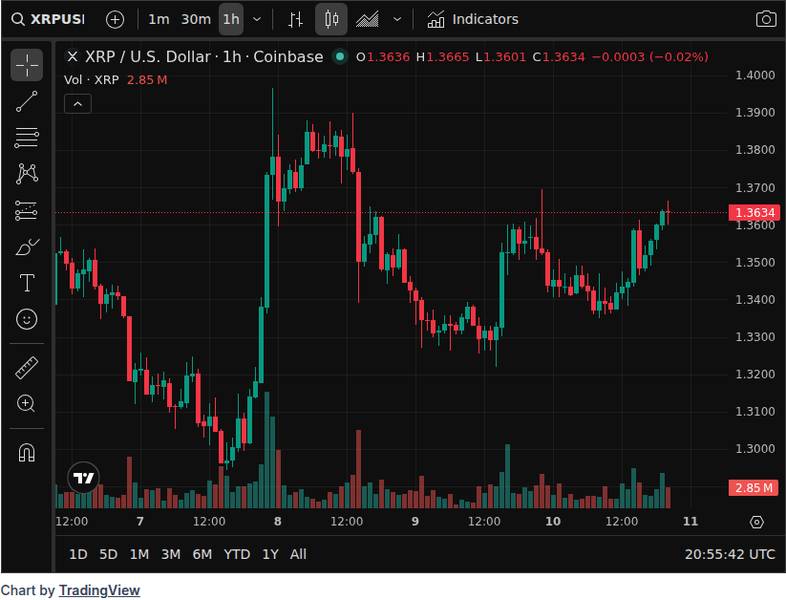
The broader crypto market remains cautious, with the Fear & Greed Index sitting at 16, deep in “Extreme Fear” territory. That backdrop makes any disruption to order book integrity on a major pair more consequential, as thin-market conditions amplify the impact of spoofing on real execution quality. Traders watching XRP’s price structure and upcoming regulatory catalysts will want to factor in whether DEX liquidity conditions stabilize.
Why XRP/RLUSD Attracted the Bots
The XRPL DEX operates with native order books and an auto-bridging mechanism that routes token-to-XRP and XRP-to-token trades when that path offers better rates than direct token-to-token execution. That design means the XRP/RLUSD pair sits at a strategic junction, where manipulating one book can cascade into related markets.
Newer stablecoin pairs on decentralized exchanges tend to attract spoofing strategies precisely because liquidity is still developing. Thin books make it cheaper to create convincing ghost walls, and the presence of automated market makers and arbitrage bots creates a ready pool of targets. The question of how blockchain networks handle emerging technical threats extends well beyond quantum computing into everyday trading infrastructure.
The fact that XRPL processed the entire spoofing wave without fee spikes or settlement delays is itself a data point. Vet framed the throughput resilience as evidence that the ledger functions as “financial infrastructure that scales,” even under adversarial conditions. Whether that framing holds depends on whether the spoofing was merely absorbed or actually deterred.
For RLUSD to function as a serious institutional stablecoin on XRPL, the XRP/RLUSD pair needs order book conditions that institutional desks can trust. As regulatory frameworks like MiCA tighten standards around market integrity for crypto venues, how decentralized ledgers handle manipulation attempts will face increasing scrutiny.
What traders should watch next: whether XRPL validators or developers propose protocol-level changes to penalize rapid offer creation and cancellation patterns, and whether RLUSD trading volume on the DEX grows or retreats in the days following this incident.
Disclaimer: This article is for informational purposes only and does not constitute financial or investment advice. Cryptocurrency and digital asset markets carry significant risk. Always do your own research before making decisions.