
Post-Ceasefire Crypto Outlook: Hangover or Buying Opportunity?
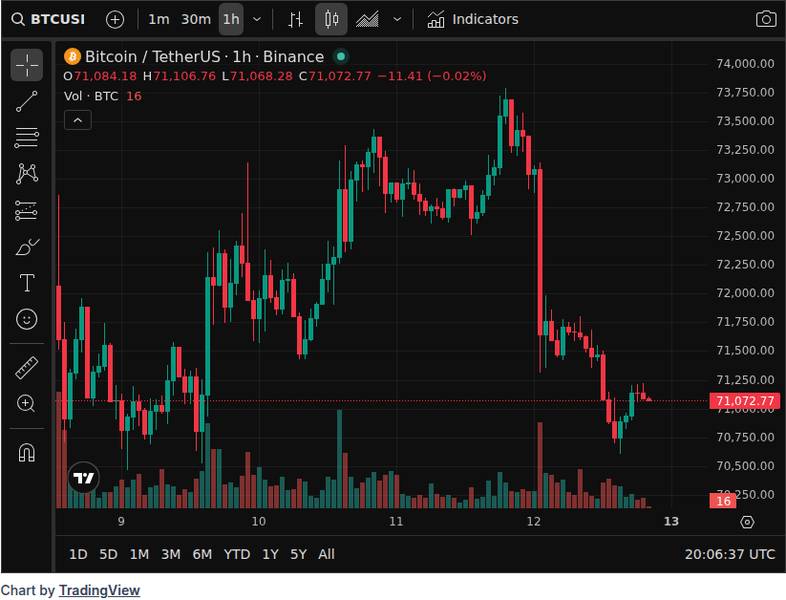
Bitcoin’s ceasefire-driven rally above $72,000 has already faded to $71,112, with the Fear and Greed Index sitting at Extreme Fear and a 3.3% pullback in the last 24 hours raising the question of whether the initial spike was a one-day event or the start of a broader recovery.
On April 7, 2026, President Donald Trump announced he would suspend bombing Iran for two weeks if Iran agreed to the complete, immediate, and safe opening of the Strait of Hormuz. The statement, originally posted on Truth Social and released by the White House, described the arrangement as a double-sided ceasefire following conversations with Pakistani leadership.
Markets reacted immediately. S&P 500 futures advanced 2.3% and Dow futures rose 2%, while U.S. crude fell 14.3% to $96.83 and Brent fell 13.3% to $94.74. Bitcoin peaked at $72,379 on April 8, up 3.5% in 24 hours.
Five days later, much of that move has unwound. BTC trades at $71,112 with a market cap of $1.42 trillion and 24-hour volume near $28 billion.
Why the Relief Rally May Already Be Fading
The pattern is familiar: geopolitical de-escalation triggers a cross-asset spike, traders take profit within days, and the underlying macro backdrop reasserts itself. Bitcoin’s -3.3% 24-hour decline suggests exactly that sequence is playing out.
The ceasefire reduced panic demand for hedges but did nothing to improve underlying liquidity conditions. Oil prices collapsed, equity futures jumped, and crypto briefly followed, yet the catalyst was a conditional two-week pause, not a permanent resolution.
According to unconfirmed reports from Decrypt citing CoinGlass, the initial rally liquidated $425 million in short crypto positions and another $170 million in longs. That kind of two-sided flush often exhausts near-term momentum rather than building it, similar to the volatility patterns seen during recent quantum computing fears around XRP and Bitcoin.
The Fear and Greed Index reads 16, classified as Extreme Fear. That reading, taken five days after the ceasefire announcement, shows sentiment never shifted meaningfully despite the initial price spike.
WHAT TO KNOW
- Downside case: Relief rally already priced in; Extreme Fear persists; two-week ceasefire too fragile to sustain risk-on positioning
- Upside case: If Bitcoin holds above $70,000 while volatility compresses, the pullback could become a higher low within a broader recovery
Conditions That Would Turn Weakness Into a Buying Setup
The bullish case requires Bitcoin to hold current levels while the ceasefire headline fades from dominance. If BTC stabilizes near $71,000 rather than sliding toward $68,000, traders may interpret the pullback as constructive consolidation rather than trend breakdown.
Analyst Andri Fauzan Adziima noted that the pause provides fragile breathing room after weeks of escalation, but skepticism remains high over whether it will hold beyond two weeks. That fragility means any bullish thesis is conditional on follow-through from both geopolitical and market signals.
A stabilization in Bitcoin could also reopen the door for capital rotation into higher-beta altcoins. Total crypto market cap sits at $2.5 trillion with Bitcoin dominance at 56.9%, suggesting altcoins have not yet participated meaningfully in any recovery. Developments in DeFi lending markets and broader protocol activity would signal whether risk appetite is genuinely returning.
The distinction matters: healthy consolidation holds key support on declining volume, while a breakdown accelerates on rising volume with no bid absorption. The next few days of price action around $70,000-$71,000 will clarify which scenario is unfolding.
Signals to Monitor After the First Move
Bitcoin dominance is the first tell. If dominance rises above 57% while price drops, it signals defensive rotation, not recovery. If dominance holds steady or dips while BTC stabilizes, broader market confidence may be returning.
Spot volume trends matter more than futures open interest at this stage. The $28 billion in 24-hour BTC volume needs to hold or expand for any dip-buying thesis to gain traction. Declining volume on a flat price would suggest indifference rather than accumulation, a pattern worth comparing against recent ETF flow trends across Bitcoin, Ethereum, Solana, and XRP.
Macro risk appetite still drives the medium-term picture. The ceasefire is conditional on Iran’s compliance, and the two-week window expires around April 21. Any escalation before that date would unwind the remaining relief premium. Traders should track oil prices and equity futures alongside crypto for confirmation of sustained de-escalation.
The answer to the headline sits in the data: the ceasefire lifted prices, but Extreme Fear at 16, a fading rally, and a conditional two-week window suggest the market is pricing in a hangover, not a breakout. A clean buying opportunity requires Bitcoin to hold $70,000, volume to stabilize, and the ceasefire to extend beyond its initial deadline.
Disclaimer: This article is for informational purposes only and does not constitute financial or investment advice. Cryptocurrency and digital asset markets carry significant risk. Always do your own research before making decisions.