
XRPL AMM Amendment Could Close XRP Ledger’s Biggest DeFi Gap
A draft amendment filed on May 26, 2026 would bring concentrated liquidity and StableSwap curves to the XRP Ledger’s native automated market maker, targeting what developers call the chain’s most significant DeFi shortcoming.
The proposal, titled “AMM Swappable Curves” and filed as discussion #547 on the XRPL Standards repository, was authored by core developers Denis Angell and Roman Thpt. It introduces three pluggable curve types: the existing constant product model (CurveType 0), concentrated liquidity (CurveType 1), and StableSwap (CurveType 2).
A fourth “Smart AMM” type built on WASM hooks is reserved for a separate future specification. The curve type chosen at pool creation is immutable; migrating to a new curve requires withdrawing liquidity and redeploying into a fresh pool.
What the New AMM Amendment Proposes for XRPL
XRPL’s on-chain governance works through validator voting. An amendment must secure sustained supermajority support from validators before activating on the network. The AMM Swappable Curves proposal does not yet appear in XRPL’s official Known Amendments registry, confirming it remains at the draft discussion stage.
The XRP Ledger Foundation stated that the new pool curves, including StableSwap and concentrated liquidity, “increase capital efficiency and stabilize pricing for stablecoins, FX markets, RWAs.”
“New pool curves StableSwap & Concentrated Liquidity increase capital efficiency and stabilize pricing for stablecoins, FX markets, RWAs”
— XRP Ledger Foundation (@XRPLF)
Passage is not guaranteed. The amendment must clear the full XRPL voting process, which can take months. Validators have not yet begun formally voting on this proposal, and no timeline for a vote threshold has been announced.
Why XRPL’s AMM Has Lagged Behind Other L1 DeFi Ecosystems
XRPL launched its native AMM in 2024, but the implementation shipped with only a single curve type: constant product. That model, equivalent to Uniswap v2’s formula, spreads liquidity uniformly across all price ranges, making it capital-inefficient for tightly traded pairs like stablecoins or tokenized assets.
Roughly 60% of AMM volume across major DeFi ecosystems now runs through some version of concentrated liquidity. XRPL has lacked this since its AMM launched, leaving its decentralized exchange at a structural disadvantage against Ethereum and Solana-based protocols that adopted Uniswap v3-style designs years ago.
The gap shows in the numbers. XRPL’s native DeFi total value locked sits at approximately $46.89 million per DeFiLlama data, a figure dwarfed by the over $3 billion in tokenized real-world assets already on the ledger. A Ripple-JPMorgan pilot reportedly settled a tokenized U.S. Treasury redemption in under five seconds earlier this month, though specific transaction details have not been independently confirmed by a second source.
That roughly 64-to-1 ratio between institutional assets on-chain and functional DeFi infrastructure highlights the disconnect. Tokenized RWAs are arriving on XRPL, but there are almost no DeFi rails to deploy them productively. As XRPL approaches milestones like the 300,000 account threshold that has drawn analyst scrutiny, the absence of competitive AMM tooling becomes harder to ignore.
XRPL AMM pools have still grown meaningfully since launch, reaching 29,488 active pools with over 12.8 million XRP pooled as of May 2026.
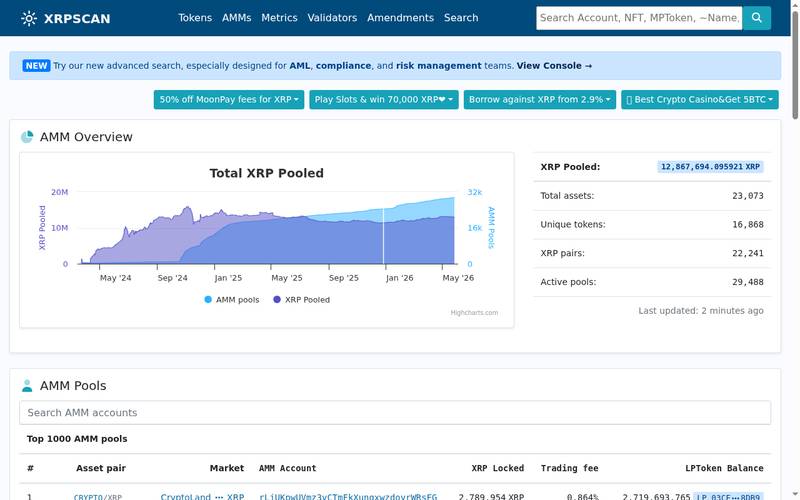
Pool count alone, however, does not solve capital efficiency. Without concentrated liquidity, liquidity providers on XRPL earn less per dollar deployed than their counterparts on chains that support tighter price ranges.
What Passes or Fails Next Determines XRPL DeFi’s Near-Term Trajectory
If the amendment passes, liquidity providers on XRPL would gain the ability to concentrate capital within specific price bands for the first time. StableSwap curves would also allow stablecoin and FX pairs to trade with minimal slippage, a feature critical for institutional use cases involving the tokenized assets already on the ledger.
For XRP holders, the implications extend beyond trading mechanics. Concentrated liquidity pools typically attract deeper liquidity and tighter spreads, which could make XRPL’s native DEX more competitive for the kind of institutional volume that recent policy developments around XRP have been positioning the network to capture.
The broader market backdrop adds uncertainty. XRP traded at $1.33 at press time, down 2.25% over 24 hours, with a market cap of $82.26 billion. The Crypto Fear & Greed Index registered 34, squarely in “Fear” territory. XRP sits roughly 63% below its all-time high of $3.65, reached in July 2025.
Community and validator concerns could slow or block the proposal. The curve immutability design means existing pool operators cannot upgrade in place; they must withdraw and redeploy. That friction could fragment liquidity during any transition period, a tradeoff developers will need to address as the XRPL ecosystem continues to scale.
The concrete milestones to watch: whether the proposal advances from discussion to a formal amendment candidate, how quickly validators signal support, and whether the reserved Smart AMM specification materializes as a follow-up. Until validators begin casting votes, the XRPL AMM upgrade remains a technical blueprint, not a guarantee.
Disclaimer: This article is for informational purposes only and does not constitute financial or investment advice. Cryptocurrency and digital asset markets carry significant risk. Always do your own research before making decisions.