



Solana trades nearly 72% below its all-time high while active validators have fallen more than 68%, but the headline comparison needs context.
Solana trades at $82.30, nearly 72% below its all-time high of $293.31, while the network’s active validator count has shrunk by more than 68% from its peak. Both declines are steep, but the neat comparison circulating online does not hold up under scrutiny.
WHAT TO KNOW
- Price drawdown: SOL is down 71.9% from its January 2025 all-time high, not 68%.
- Validator decline: Active validators with significant stake fell from over 2,500 to roughly 800, a drop exceeding 68%.
The 68% price-drop framing no longer holds
The original headline pegged Solana’s price decline at 68% from its all-time high. CoinGecko data tells a different story: SOL hit $293.31 on January 19, 2025, and at $82.30 on April 12, 2026, the actual drawdown is 71.9%.
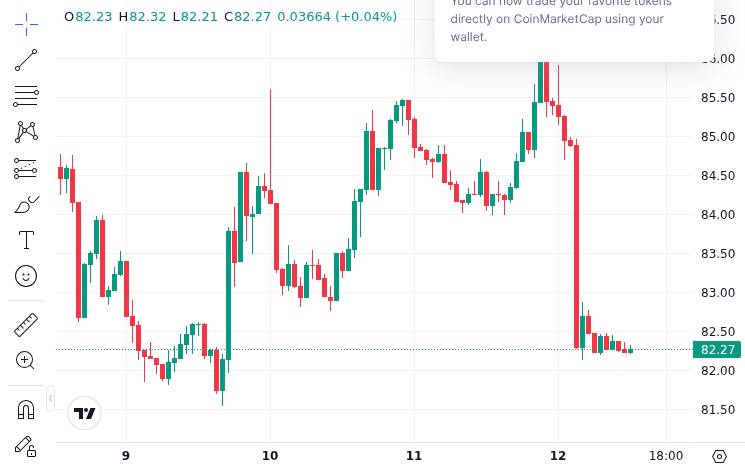
The timing matters too. On January 29, 2026, when the validator-decline story first circulated, SOL was trading at roughly $125.04, about 57.4% below its ATH. The “same rate” comparison was already a stretch at that point; three months of further price erosion has widened the gap further.
SOL’s market cap currently sits at $47.3 billion with 24-hour trading volume of $2.79 billion, while the broader crypto market registers an Fear & Greed Index score of 16, deep in “Extreme Fear” territory. That risk-off backdrop adds pressure to an asset that has already lost nearly three-quarters of its peak value, a trend that other major altcoins like Ethereum are also navigating as Q2 unfolds.
What Solana’s shrinking validator count actually shows
The validator side of the story requires careful definition. Solana Compass currently lists 759 staked validators and 5,005 full nodes on the network. Its validator-count-over-time chart only counts a node as an active validator when it holds more than 15,000 SOL in delegated stake.
A 21Shares research report noted that active validators dropped by over 68%, to around 800 from more than 2,500. That decline is significant, but the threshold used to define “active” filters out smaller operators that still participate in the network.
The Solana Foundation uses a broader measure. Its June 2025 Network Health Report listed 1,295 total consensus validators, a substantially higher figure than the 759 staked validators Solana Compass counts under its stricter methodology. The difference is not contradictory; it reflects two valid ways of measuring network participation.
Solana’s Nakamoto coefficient, the minimum number of validators that could theoretically collude to halt the network, currently stands at 20. That figure has remained stable even as the overall validator count declined, suggesting that stake distribution among the top validators has not concentrated dramatically. For investors tracking how institutional frameworks evaluate crypto network resilience, this distinction between validator quantity and stake concentration matters.
Why methodology matters more than matching percentages
The original headline drew a clean parallel: price down 68%, validators down 68%. The verified data shows these are two separate signals moving at different speeds. SOL’s price drawdown is steeper than 68%, and the validator decline depends heavily on which counting method you use.
No regulatory catalyst or enforcement action drove either decline. This is a story about market structure and network participation economics, not a policy event. The cost of running a Solana validator with meaningful stake has effectively priced out smaller operators, while the token’s price decline reflects broader market conditions that have pushed sentiment into extreme fear territory.
Coverage elsewhere did not reconcile the headline’s price claim with current market data, repeating the 68% figure without checking it against live pricing. The actual picture is less symmetrical but more informative: Solana’s validator base has contracted sharply under strict definitions, and its token price has fallen even further than the headline suggested. Both trends deserve attention on their own terms, not as a forced numerical coincidence. For those weighing how institutional asset managers evaluate crypto network fundamentals, the validator methodology question is as important as the price chart.
Disclaimer: This article is for informational purposes only and does not constitute financial or investment advice. Cryptocurrency and digital asset markets carry significant risk. Always do your own research before making decisions.
