

Mirae Asset Securities is preparing to enter Hong Kong’s retail cryptocurrency market, signaling new competition and broader access for local crypto investors.
Mirae Asset Securities announced on April 15 that its Hong Kong subsidiary has received final approval for a digital asset retail license from the Securities and Futures Commission, positioning the South Korean brokerage to offer cryptocurrency trading to individual investors in Hong Kong as early as June 2026.
What Mirae Asset Securities’ Hong Kong Retail Crypto Push Signals
The approval marks a shift for Mirae Asset Securities (HK) Limited, which previously operated under a professional-investor-only condition for virtual asset dealing services. SFC records from December 2023 show the firm’s earlier license restricted digital asset services to professional investors. The upgrade to a retail-capable license opens a new client segment entirely.
Mirae Asset plans to launch a mobile trading system in June 2026 that would let individual investors in Hong Kong trade digital assets directly. According to the company, the platform will link traditional assets, tokenized assets, and other digital assets in a single ecosystem.
Sung Joon-yeop, Mirae Asset’s Hong Kong CEO, framed the license as a foundation for a broader product vision:
“Through this license acquisition, we have established a new investment ecosystem that organically connects traditional assets and digital assets. We plan to develop it into a comprehensive platform that integrates real-linked assets (RWA) and tokenization-based digital assets into mobile platforms.”
— Sung Joon-yeop, CEO, Mirae Asset Securities (HK) Limited (via Maeil Business Newspaper)
The move is notable because it comes from a traditional securities firm, not a crypto-native company. Mirae Asset is one of South Korea’s largest financial groups, and its entry into retail crypto dealing through a regulated Hong Kong entity signals growing institutional confidence in the territory’s virtual asset framework.
Why Hong Kong’s Retail Crypto Market Matters Right Now
Hong Kong’s SFC has built a regulatory structure that explicitly allows licensed intermediaries to serve retail virtual asset clients, but with strict guardrails. Under the SFC’s terms, retail trades must flow through an omnibus account held at an SFC-licensed platform that is not restricted to professional investors.
Retail clients may only trade virtual assets that an SFC-licensed platform has approved for retail trading. The regulator also requires intermediaries to conduct client knowledge and risk-tolerance assessments, enforce exposure limits of less than 10% of gross account value for discretionary allocations, and provide clear disclosure on which assets are available to retail users.
These controls distinguish Hong Kong’s approach from less regulated jurisdictions. The framework creates a middle ground where retail investors gain access to digital assets through licensed intermediaries while remaining subject to suitability checks similar to those in traditional securities markets.
SFC records from February 2026 show that Mirae Asset Securities (HK) Limited had its Type 1 virtual-asset dealing condition updated, with the earlier professional-investor restriction replaced by an omnibus-account terms-and-conditions requirement. That regulatory paper trail suggests the firm had been working toward retail eligibility for months before the April 15 announcement.
The expansion arrives during a period of subdued market sentiment. Bitcoin traded near $74,337 with a market capitalization of roughly $1.49 trillion, while the Fear & Greed Index sat at 23, deep in “Extreme Fear” territory.
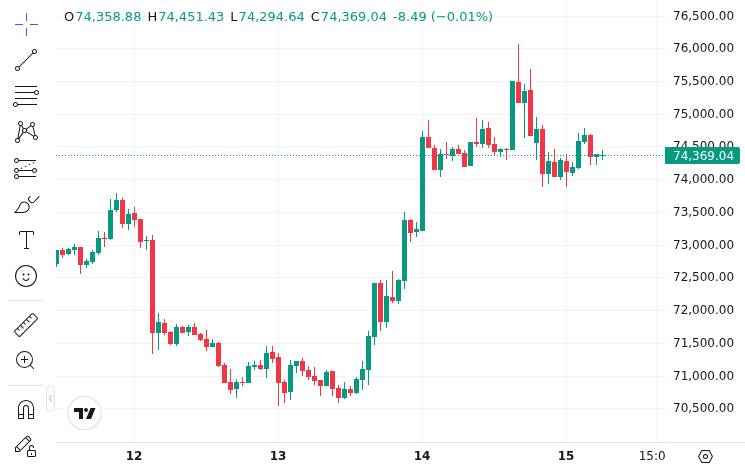
Launching retail crypto services into a fearful market could be a calculated timing play. Institutional entrants often build infrastructure during downturns, positioning for the next cycle of retail demand. The evolving stablecoin regulatory landscape in major markets adds another layer of urgency for firms seeking early-mover advantage in compliant crypto offerings.
What the Move Could Mean for Competition and Investor Access
Mirae Asset’s entry adds a well-capitalized traditional finance player to Hong Kong’s growing roster of licensed virtual asset intermediaries. For existing crypto-native platforms operating in the territory, the competitive pressure is tangible: a firm with established brokerage infrastructure, compliance teams, and brand recognition among traditional investors now competes for the same retail client base.
The firm’s stated ambition to combine traditional assets with tokenized and digital assets in one platform could prove particularly disruptive. If Mirae delivers a single interface where Hong Kong retail investors can trade equities, bonds, tokenized real-world assets, and cryptocurrencies, it would offer a value proposition that standalone crypto exchanges cannot easily match. The growing interest in tokenized and staked digital assets across the broader market suggests demand for exactly this kind of integrated access.
However, key details remain unconfirmed. No standalone SFC press release or public register entry independently confirming the final retail-license approval was located beyond the company’s own statement as reported by Maeil Business Newspaper. The June 2026 mobile trading launch is also a forward-looking company plan, not a confirmed product.
The broader question is whether Mirae’s move signals a wave of traditional brokerages following the same path into Hong Kong’s retail crypto market. With regulatory infrastructure now in place and at least one major securities firm navigating the approval process to completion, other traditional finance players with Hong Kong operations, including those with existing crypto exposure at the executive level, may face pressure to develop competing retail digital asset offerings or risk ceding a growing market segment.
Disclaimer: This article is for informational purposes only and does not constitute financial or investment advice. Cryptocurrency and digital asset markets carry significant risk. Always do your own research before making decisions.