

Polygon has launched sPOL, a liquid staking token aimed at unlocking native DeFi activity across its ecosystem. Here is what the rollout means.
Polygon has launched sPOL, a liquid staking token designed to let POL holders earn staking rewards while deploying their capital across native DeFi applications. The rollout, confirmed by the official Polygon X account on April 14, 2026, arrives alongside a governance push to route more network fees toward stakers.
WHAT TO KNOW
- sPOL is a liquid staking token issued by Polygon Labs. Users deposit POL into the sPOL smart contract and receive sPOL as a receipt that accrues staking rewards over time.
- sPOL supports staking and redemption on both Ethereum and Polygon, with an unbonding period of approximately 2-3 days.
According to Polygon Labs’ official terms page, depositing POL into the sPOL smart contract mints sPOL as a receipt for the staked position. The token accrues staking rewards over time and may be used in DeFi applications, effectively letting holders put staked capital to work.
Redemptions are subject to the protocol’s unbonding period, currently ranging from approximately 2-3 days. The token supports both staking and redemption on Ethereum and Polygon.
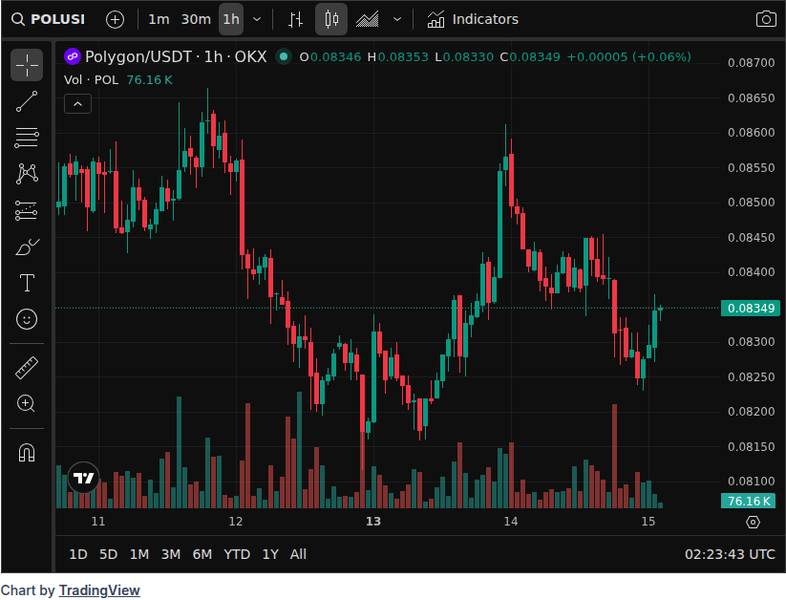
POL traded at $0.083 at press time, with a market cap near $886 million and 24-hour trading volume of roughly $46.7 million.
How liquid staking can expand Polygon-native DeFi
Traditional staking locks tokens in validator contracts, removing them from circulation. Liquid staking tokens like sPOL solve this by issuing a transferable receipt that represents the staked position, letting holders participate in lending, liquidity provision, or other onchain activity without sacrificing staking yield.
For Polygon’s ecosystem, the timing is notable. The chain currently holds roughly $1.32 billion in total value locked across its DeFi protocols. That existing base gives sPOL immediate venues for deployment, whether as collateral, in liquidity pools, or within lending markets.
The concept mirrors what liquid staking has already done on other networks. Much like how evolving regulatory frameworks are reshaping crypto market structure, liquid staking products are reshaping how capital flows within proof-of-stake ecosystems by removing the binary choice between securing the network and participating in DeFi.
Why the sPOL rollout matters for Polygon’s ecosystem
The launch does not exist in isolation. Polygon’s governance forum hosts PIP-85, a proposal to send 50% of the validator pool’s priority fees directly to stakers. The same proposal notes that priority fees have increased 1,000% since the PIP-65 system took effect, meaning there is a growing revenue stream that stakers, and by extension sPOL holders, stand to benefit from.
That fee-sharing mechanism could make sPOL more attractive over time if PIP-85 passes. Staking rewards tied to network usage, rather than fixed inflation schedules, give the token a revenue component that scales with Polygon’s adoption.
Polygon’s official terms page does flag that the regulatory treatment of liquid staking tokens remains unsettled across jurisdictions, explicitly referencing SEC and CFTC enforcement risk. The disclosure also notes access restrictions for sanctioned or restricted geographies, a reminder that regulatory clarity around staking products, much like the broader intersection of traditional finance and crypto assets, remains a work in progress.
According to unconfirmed reports from secondary coverage, Polygon may be committing 100 million POL to bootstrap initial sPOL liquidity. No primary Polygon source has confirmed that figure.
The broader market context adds nuance to the launch timing. The Fear and Greed Index sat at 23, registering Extreme Fear, during the announcement window. Launching a capital-efficiency product when sentiment is depressed could position sPOL to capture users looking to maximize yield on assets they plan to hold through a downturn, a period where institutional crypto exposure continues to surface in unexpected places.
For Polygon users and builders, sPOL represents a native tool that did not previously exist in the ecosystem’s toolkit. Whether it gains meaningful adoption will depend on DeFi integrations, the unbonding experience, and whether governance proposals like PIP-85 deliver on their promise to make staking on Polygon more rewarding.
Disclaimer: This article is for informational purposes only and does not constitute financial or investment advice. Cryptocurrency and digital asset markets carry significant risk. Always do your own research before making decisions.