
Ripple Secures $200 Million Debt Facility to Expand Prime Brokerage Business
Ripple has closed a $200 million debt facility through Neuberger Specialty Finance to expand its prime brokerage unit, Ripple Prime, marking one of the largest dedicated financing arrangements for institutional crypto infrastructure this year.
The company announced on May 11, 2026 that the facility allows Ripple Prime to draw up to $200 million and deploy the proceeds to extend financing to clients operating across traditional and digital markets.
WHAT TO KNOW
- Facility size: $200 million debt facility from funds managed by Neuberger Specialty Finance
- Purpose: Expand Ripple Prime’s lending capacity for institutional clients across equities, fixed income, and crypto
Ripple said Ripple Prime has tripled its revenue year over year since the company acquired the platform in 2025. The unit now clears more than $3 trillion annually and serves more than 300 institutional customers.
What Ripple Prime Does and Why the Facility Matters
Prime brokerage in crypto markets covers a bundle of services that institutional traders rely on: margin lending, trade execution, clearing, and custody. For hedge funds and asset managers that trade across both digital assets and traditional securities, a single prime broker that spans both reduces operational friction and counterparty risk.
The debt facility is designed to expand margin available to investors trading across equities, fixed income, and crypto. Noel Kimmel, a Ripple executive, framed the move in terms of institutional demand.
“Dependable access to financing and balance sheet strength are critical to institutional participants in today’s dynamic markets.”
— Noel Kimmel, Ripple
Peter Sterling of Neuberger Specialty Finance described Ripple Prime as combining “fintech-grade technology and agility with bank-level compliance and operational rigor.” The backing from a traditional asset management firm signals growing comfort among legacy finance players with crypto-native infrastructure, a trend that has also seen Switzerland’s largest bank push into mass-market crypto services this year.
Ripple’s Regulatory Footprint Underpins the Expansion
What separates this facility from a typical crypto fundraise is Ripple Prime’s regulatory positioning. An SEC Crypto Task Force memo from a March 20, 2026 meeting shows that Ripple Prime representatives told SEC staff that Ripple subsidiaries hold over 75 global financial services licenses, including a Commission-registered broker-dealer and a CFTC-registered futures commission merchant.
That licensing depth matters for institutional clients who need regulated counterparties. It also explains why a firm like Neuberger Specialty Finance, which operates within traditional credit markets, would extend a nine-figure facility to a crypto-adjacent borrower.
Ripple’s regulatory history is not without friction. The SEC’s long-running litigation against the company concluded in August 2025 when both sides dismissed their appeals, but the district court’s final judgment remained in effect, including a $125,035,150 civil penalty and an injunction tied to Securities Act registration provisions. The resolution, while not a clean victory, removed the overhang that had constrained Ripple’s institutional ambitions for years.
What the Move Could Signal for Institutional Crypto
A $200 million debt facility dedicated to prime brokerage expansion reflects a broader pattern: institutional crypto infrastructure is attracting traditional financing on traditional terms. Debt facilities, unlike equity raises, impose repayment obligations and require lender confidence in cash flow, which suggests Neuberger sees Ripple Prime’s revenue trajectory as bankable.
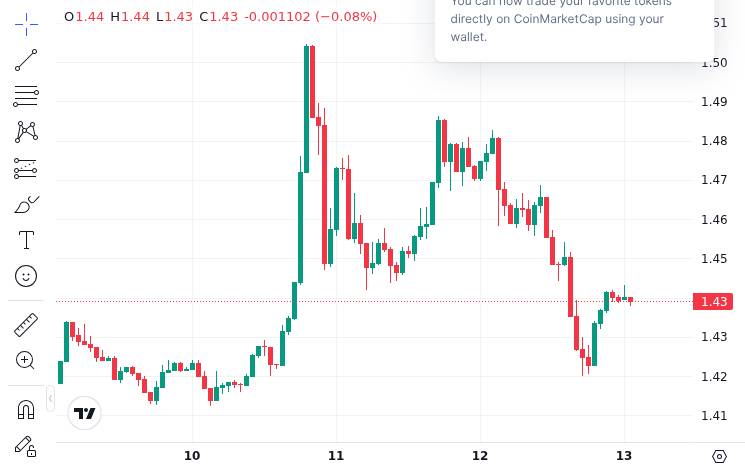
The timing aligns with a market environment where institutional demand for cross-asset trading is growing but macroeconomic uncertainty has kept risk appetite cautious. XRP traded at $1.44 at press time, down roughly 2.4% over 24 hours, with a market cap near $88.9 billion.
The crypto Fear & Greed Index sat at 49 at the time of announcement, reflecting neutral sentiment. For Ripple, the facility is less about market timing and more about building permanent infrastructure. With the SEC litigation resolved, over 75 licenses in hand, and revenue tripling year over year, Ripple Prime is positioning itself as a regulated bridge between traditional finance and digital assets.
The question now is whether competing prime brokers, including those from legacy banks exploring crypto custody and clearing, will pursue similar debt-backed expansion strategies or cede the cross-asset institutional market to crypto-native platforms.
Disclaimer: This article is for informational purposes only and does not constitute financial or investment advice. Cryptocurrency and digital asset markets carry significant risk. Always do your own research before making decisions.