



Already using cold storage? Run this year-end audit built on 2026 events: the Coldcard weak-seed thefts, tampered Ledger devices, a triage table and a 7-step checklist.
Cold storage means keeping the secret that controls your Bitcoin on a device that is not connected to the internet. Most people assume that once it is set up, it stays safe. In 2026 that assumption failed in two real ways: a hardware wallet generated guessable keys, and other devices were tampered with before they reached buyers. This guide is for people who already hold Bitcoin offline and want to check the setup, and it opens with a quick table so you can tell within a minute whether you need to act today.
Price context, from CoinGecko on 2026-11-17: Bitcoin at $65,012, down 12.7% over 7 days and 20.6% over 30 days, and 48.4% below its all-time high of $126,080 (6 October 2025). Falling prices are a poor reason to skip maintenance, because the thefts below were of coins, not dollars.
Which situation are you in?
| Your situation | What to do first | Where in this guide |
|---|---|---|
| You use a Coldcard and made the seed before the fixed firmware for your model | Treat the seed as exposed unless the dice exception applies. Migrate to a new seed. | Steps 2 and 3 |
| You bought a Ledger from a marketplace, a third-party seller or a discount reseller | Do not trust it. Do not set it up. If already in use, move funds to a new device and new seed. | Step 4 |
| You use another brand and bought direct from the maker | Run the full audit. No 2026 incident described here applies to you automatically. | Steps 1 to 7 |
| You are new and have no cold storage yet | Read the terms below, then buy from the maker's own store and follow Step 5 for backups. | Terms, Steps 4 to 5 |
Terms used in this guide
| Term | Plain meaning |
|---|---|
| Seed phrase | The 12 or 24 words that can recreate your wallet. Whoever has them controls the Bitcoin. |
| Entropy | Randomness. A seed is only safe if the random numbers used to create it cannot be guessed. |
| RNG | Random number generator, the part of a device that produces that randomness. |
| Passphrase (25th word) | An extra secret word added to the seed. It creates a different wallet, so the seed alone is not enough. |
| Multisig | A wallet that needs several keys (for example 2 of 3) to spend. |
| Supply-chain attack | Tampering with a product before it reaches you, for example at a reseller. |
| Seed migration | Creating a brand-new seed and sending the coins to it. Different from a firmware update. |
| Wallet fingerprint | A short ID of a wallet shown on the device, used to confirm you restored the right one. |
What happened in 2026, and why it changes the audit
Event 1: Coldcard weak seeds
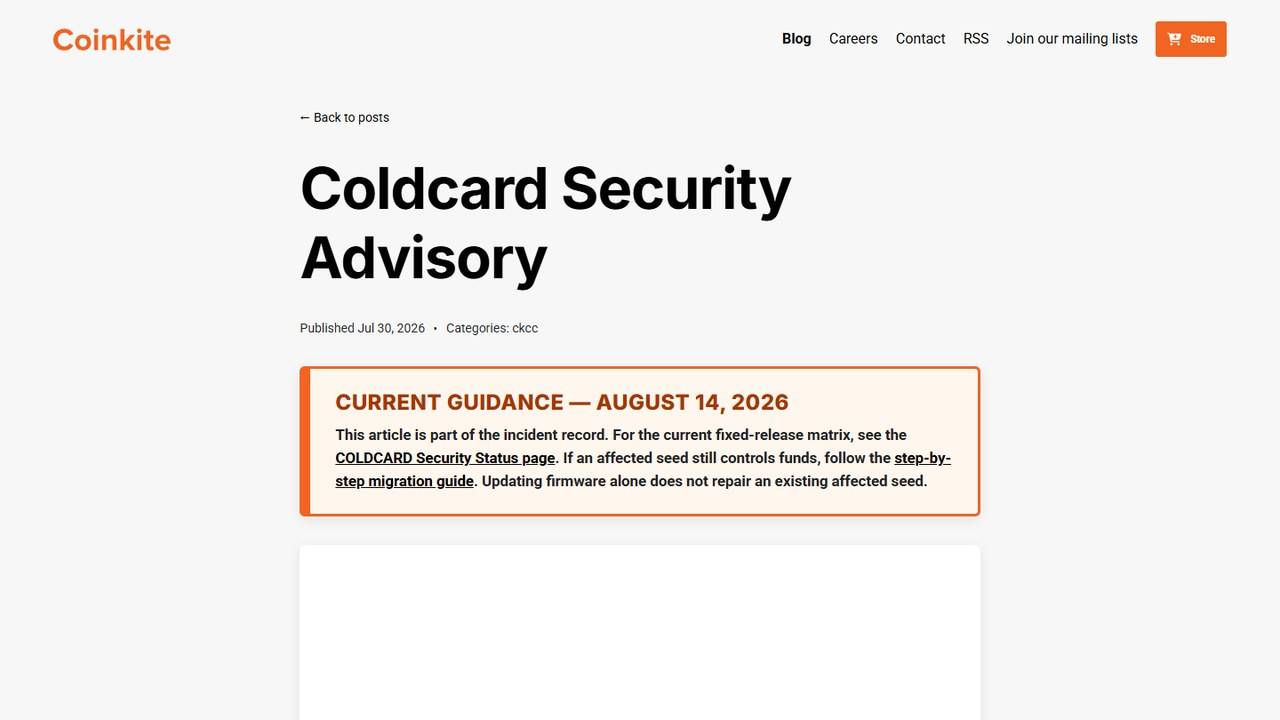
According to the Coinkite security advisory (published 30 July 2026, updated 1 August), a firmware bug caused weakened seed generation on affected Coldcard releases. Attackers regenerated the matching private keys offline and stole funds. Coinkite states the devices were not hacked or remotely taken over: the seeds were simply too predictable.
| Model | Affected seeds | Fixed firmware |
|---|---|---|
| Mk2 / Mk3 | Generated on 4.0.1 (March 2021) through 4.1.9 | 4.2.0 or later |
| Mk4 / Mk5 standard | Generated before 5.6.0 (about 72 bits of entropy instead of 128, per Coinkite) | 5.6.0 or later |
| Q standard | Generated before 1.5.0Q | 1.5.0Q or later |
| Mk4 / Mk5 Edge | Generated before 6.6.0X | 6.6.0X or later |
| Q Edge | Generated before 6.6.0QX | 6.6.0QX or later |
Source: Coinkite advisory and migration guide (last reviewed by Coinkite 2026-08-30), checked 2026-11-18. Standard and Edge are separate tracks, so a higher Edge number does not mean it is fixed.
The scale comes from TRM Labs (5 August 2026): from 30 July attackers drained about 1,816 BTC, roughly $116 million, from more than 5,200 addresses in at least four waves, with the first wave taking about 594 BTC from around 500 wallets in 25 minutes. TRM called the figures preliminary and named no actor. It said key strength fell from 128 bits to as little as 40 bits on some wallets, which differs from Coinkite's 72-bit figure for Mk4, Mk5 and Q. The older Mk2 and Mk3 releases were hit harder, which may explain it, but we could not reconcile the two numbers. Yahoo Tech, republishing BeInCrypto, cites Galaxy Research putting Coldcard losses above $115 million.
Two exceptions in the advisory matter for your own audit. Entering at least 50 fair, private dice rolls when you created the seed adds independent randomness, and Coinkite does not consider such a seed at risk from this bug alone. A strong, unique BIP-39 passphrase adds a barrier, but Coinkite still recommends migrating.
Event 2: tampered Ledger devices
BleepingComputer reported on 12 October 2026 that Ledger confirmed at least one device sold through the Malaysian reseller CryptoBilis contained an unauthorized hardware implant. Ledger asked the reseller to stop selling on 9 October and told buyers who had not set up their device not to do so. Those who had should move funds to a new signer with a new seed.
Yahoo Tech (11 October) adds that Ledger said every confirmed case involves CryptoBilis and called the volume "limited". On-chain investigators estimated losses near $90 million, which Ledger has not confirmed. Researchers cited by BleepingComputer said tampered units were sold at nearly half the normal price, and described an implant that captured screen output and button presses and sent them out over a mobile connection. Those technical details come from third-party researchers, not Ledger, and we did not verify them.
Our reading: the two incidents attack different links. Coldcard failed at creation (the seed was guessable). Ledger failed in delivery (the device was altered). An audit that only asks "is my backup safe" misses both.
The 7-step year-end audit
Step 1: Inventory what you hold and where
List every wallet, exchange account and custody arrangement, with the device model, firmware version, where it was bought and the date each seed was created. The creation date and purchase channel are new in this list because the 2026 incidents turned on exactly those two facts.
Step 2: Check how each seed was generated
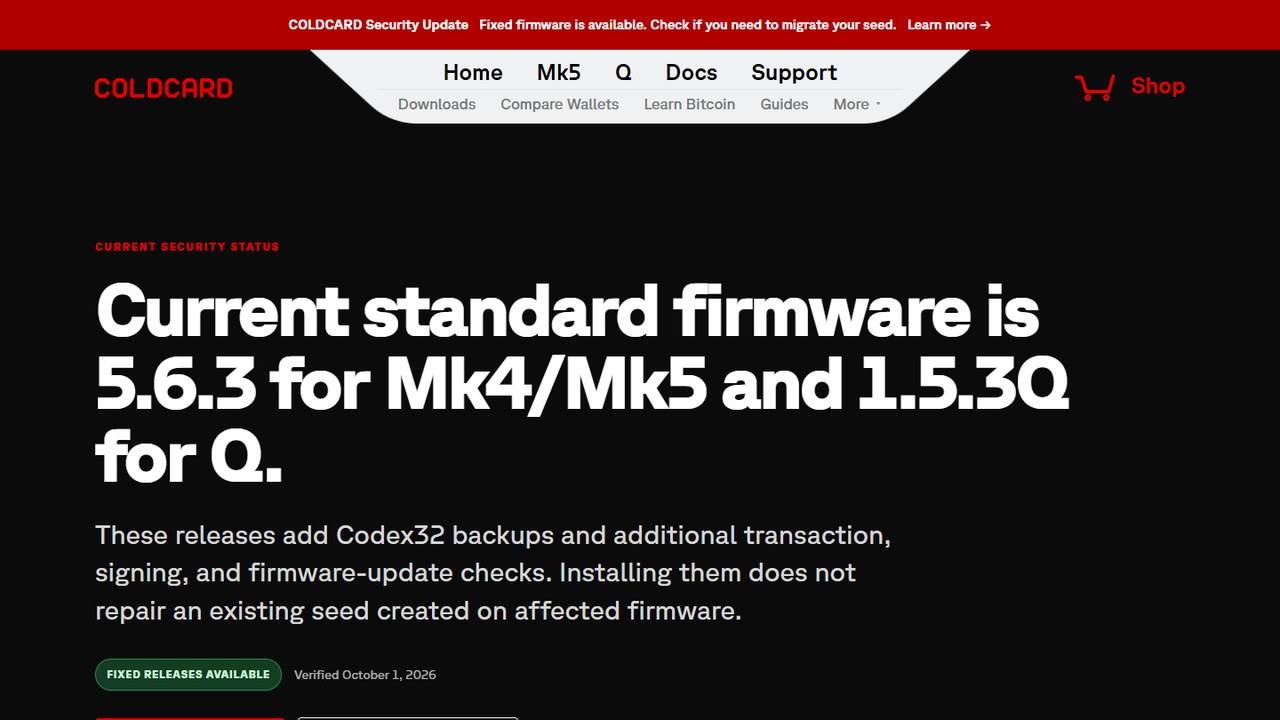
For any Coldcard, find the model and the firmware installed when the seed was made. If it predates the fixed release for your model and you did not add at least 50 private dice rolls, treat it as exposed. Coinkite's Security Status page, verified by Coinkite on 1 October 2026, lists the current matrix. If you cannot remember how the seed was made, Coinkite says to migrate. Note also that a seed generated on an affected Coldcard stays affected if you later restored, imported or cloned it elsewhere, while a seed made securely elsewhere is not weakened just because you imported it into a Coldcard.
For other brands, ask the general question: did the device produce the randomness alone, and did I add any of my own? Wallets that accept your own dice rolls let you remove trust in the chip.
Step 3: A firmware update is not a seed migration
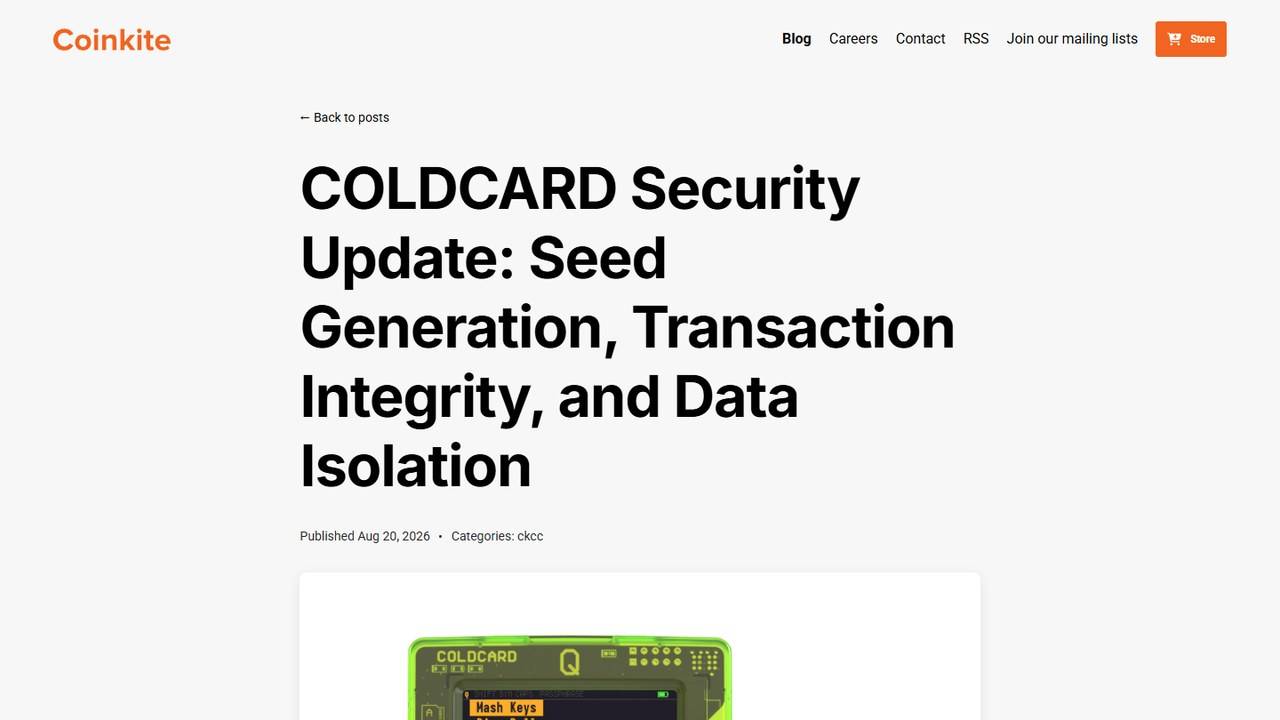
This is the most common misunderstanding. Coinkite's status page says a fixed release corrects future seed generation but does not repair an existing affected seed. The fix is a new seed on fixed firmware and a transfer of the coins. A current standard release (5.6.3 for Mk4 and Mk5, 1.5.3Q for Q, per the status page) requires one user-supplied entropy method for a new seed, per Coinkite's 20 August update: at least 65 key presses with unpredictable timing, 50 physical dice rolls or 128 coin flips.
The migration order in Coinkite's guide is worth knowing before you start:
- Install the fixed firmware and verify its SHA-256 hash and signature first.
- Prefer a second Coldcard for the new wallet, so you do not keep restoring old and new seeds on one device.
- Confirm you can recover the old wallet and record its fingerprint before changing anything.
- List every funded identity: the base wallet, passphrase wallets, BIP-85 child wallets and multisig policies that use the seed.
- Generate a completely new seed. Do not use Clone or Migrate, because it copies the old seed rather than creating a new one.
- Record and test the new backup, then send a small test transaction and check it arrived at an address you verified on the device screen.
- Move the rest only after the test works, and keep the old backup until everything has arrived.
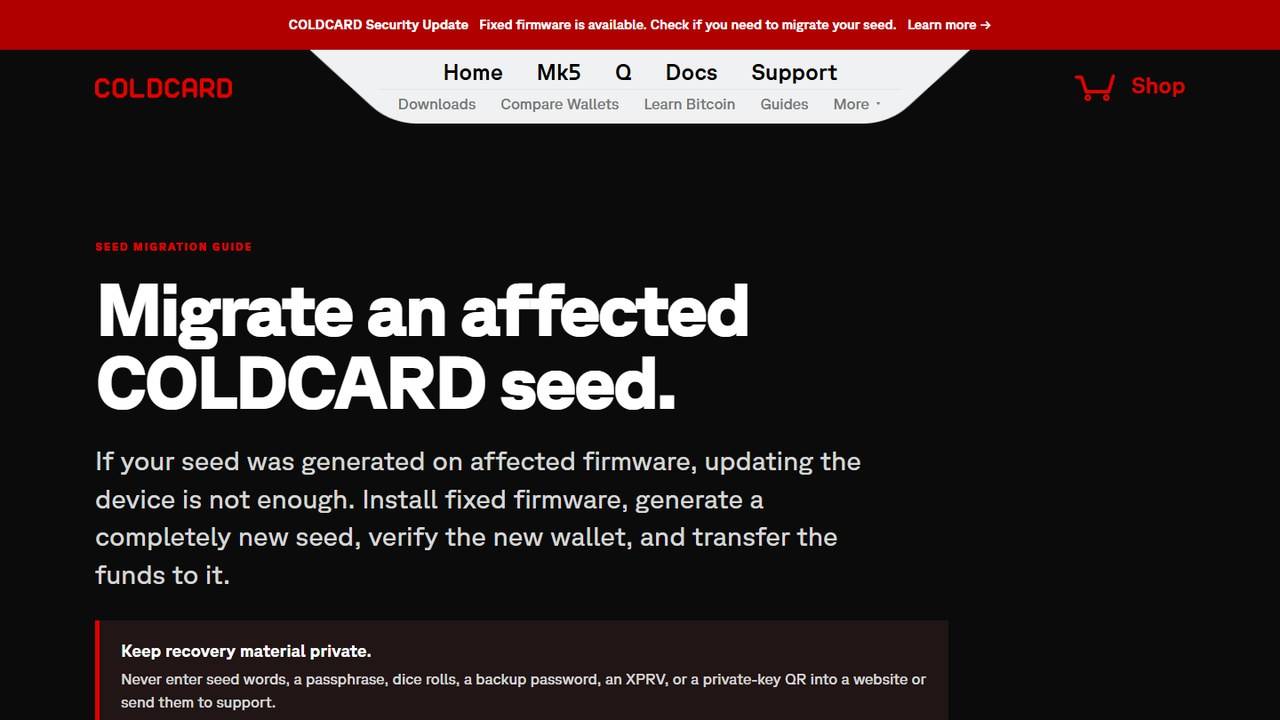
Two safety rules from the same guide: stop if a fingerprint or address does not match, and never type seed words, a passphrase or dice rolls into a website or send them to support. Our reading: the repeated test transaction is the part people skip, and it is the cheapest protection against a typo that would otherwise be permanent.
Step 4: Check where and how you bought each device
The Ledger case turns purchase history into a security control. As reported, Ledger advises buying only from Ledger or authorized resellers. A price far below retail on a marketplace is a warning sign. If a device came from a third-party seller, was opened, arrived with a pre-written seed card, or was bought secondhand, replace it and migrate. Ledger's Genuine Check confirms the security chip is authentic, but Yahoo Tech notes it cannot catch every physical change around that chip.
Shopping this season? Read our Black Friday hardware wallet guide and buy from the maker's own store.
Step 5: Review the backup
Your seed phrase is the master backup. Keep it physically separate from the signing device so one fire or burglary cannot take both. Steel plates survive fire and flood better than paper. Test recovery on a spare device with a small balance before trusting it with the main stack. If you use a passphrase, record it separately and in a form your heirs could find. A passphrase protects against theft and can also lock out your own family if it exists only in your head. Coinkite also warns that short, common or reused passphrases may be guessable.
Step 6: Consider multisig for larger balances
A 2-of-3 multisig setup with keys on devices from different makers and in different places means one weak seed or one tampered device is not enough to spend. That is the practical lesson of both incidents. It adds complexity, so practice recovery first. See our multisig wallet guide.
Step 7: Update inheritance notes
Write down where the devices and backups are, the recovery steps and who is told. Do not put the seed itself in the note. If no one else can follow your instructions, the setup has failed its most important test.
Common weaknesses we would look for
| Weakness | Why it matters in 2026 |
|---|---|
| Old Coldcard seed, no dice, no passphrase | Exposed to the weak-seed theft. Update alone does not help. |
| Passphrase wallets or BIP-85 children forgotten during migration | Each funded identity must be moved separately. |
| Device bought from a marketplace or unknown reseller | Matches the pattern in the Ledger tampering reports. |
| Seed and device stored together | One event removes both. |
| Passphrase only in memory | Can lock out heirs. |
| Exchange balance counted as cold storage | It is custody by the exchange, not self-custody. |
How we chose what to cover
On 2026-11-18 we ran three searches on DuckDuckGo: "bitcoin cold storage setup guide", "coldcard seed migration do I need to move funds" and "bitcoin cold storage audit checklist". Our reading of the results, based on titles and snippets only:
- The first query returned mostly step-by-step setup guides for new users. Those answer "how do I start", not "is my existing setup still safe", which is the gap this guide targets.
- The second returned Coinkite's own migration page plus many explainers, so we summarise the decision and link to the official steps rather than replace them.
- The third returned mostly interactive scoring tools, and several results were about refrigerated warehouses, so a written Bitcoin audit with dated 2026 evidence looked under-served.
What we did not check
- We did not test any hardware wallet or generate any seed. Incident details come from the cited publications and vendor pages.
- For the search review we read snippets and titles, not the full competitor articles. We read only the Coinkite pages in full.
- TRM Labs calls its theft figures preliminary, and its 40-bit figure differs from Coinkite's 72-bit figure for newer models. We could not confirm either.
- The Ledger loss estimate of about $90 million comes from on-chain investigators and Ledger has not confirmed a total. Implant details were reported by outside researchers.
- TRM and BleepingComputer pages did not load in our screenshot tool (a regional block and a bot check), so those were read as text and are not shown as screenshots.
- We did not verify any claim of tampered units from an official European store. Yahoo Tech says Ledger has not confirmed a case outside CryptoBilis.
- Firmware numbers and advice can change after 2026-11-18. Check the vendor status page before acting.
FAQ
Do I need to migrate if I own a Coldcard?
Only if the seed was generated before the fixed firmware for your model and the dice exception does not apply. Coinkite says to migrate if unsure. A firmware update by itself does not fix an old seed.
Is a hardware wallet still safer than keeping Bitcoin on an exchange?
It can be, if the device is genuine and the seed is strong. The 2026 incidents show that device choice, purchase channel and seed creation all matter. Exchange custody has a different risk set that we did not assess.
How often should I audit my cold storage?
At least yearly, after any change to your device, passphrase or multisig setup, and after a security advisory from your wallet maker.
How much Bitcoin needs cold storage?
There is no fixed threshold. A common rule of thumb is anything beyond what you would spend in the next month or two. At $65,012 per BTC (CoinGecko, 2026-11-17), even a small amount is meaningful for most households.
Should I keep a seed phrase in a bank safe deposit box?
It is reasonable for one copy, not the only copy, because access can be restricted by hours or court orders.
What if I cannot remember how my seed was created?
Treat it as unverified. A new seed on current, updated firmware plus a small test transfer first is the safer default.
This guide is for information only and is not financial advice. Bitcoin self-custody carries technical and operational risk. Follow your wallet maker's official documentation before moving live funds, and test with a small amount first.
