



Aave review covering V3 and V4 lending, borrowing costs, liquidation risk, wallet usability, security disclosures and its position in DeFi.
Aave is the largest onchain lending protocol, and in 2026 it runs two generations side by side: the long-running V3 app and the newer V4 “Aave Pro” interface. This review covers what I could see and verify on 9 November 2026, and where the evidence stops.
Quick verdict: Aave is the benchmark for onchain lending, with deep liquidity, a long operating record and unusually detailed security disclosures. The trade-offs are modest yields on blue-chip assets, liquidation risk when you borrow, and a split between V3 and V4 that confuses newcomers.
| Item | Detail |
|---|---|
| Best for | Lending stablecoins, borrowing against crypto, earning on idle assets |
| Fees | No account fee, interest spread built into rates, network gas on every action |
| Custody | Non-custodial, you connect your own wallet |
| Audits | 65+ audits and reviews according to Aave’s security page |
| Editorial score | 4.4 / 5 |
What I tested, and what I did not
I opened app.aave.com on desktop (1440px), tablet (1024px) and phone (430px), looked at the markets page, the security page and the V4 Aave Pro interface, then connected a throwaway MetaMask wallet that holds no funds and viewed the connected dashboard. I did not supply, borrow or repay anything, so statements about liquidation behaviour, gas costs and real borrowing rates under load come from documentation and community reports, not from my own positions.
What Aave actually is
Aave is a pool-based money market. Suppliers deposit assets and earn a variable rate, borrowers post collateral and pay a variable rate, and smart contracts handle liquidations when a loan becomes under-collateralised. The Core V3 market on Ethereum showed about $29.5B in total deposits, $12.0B in total loans and $9.0B in current borrows when I captured it.
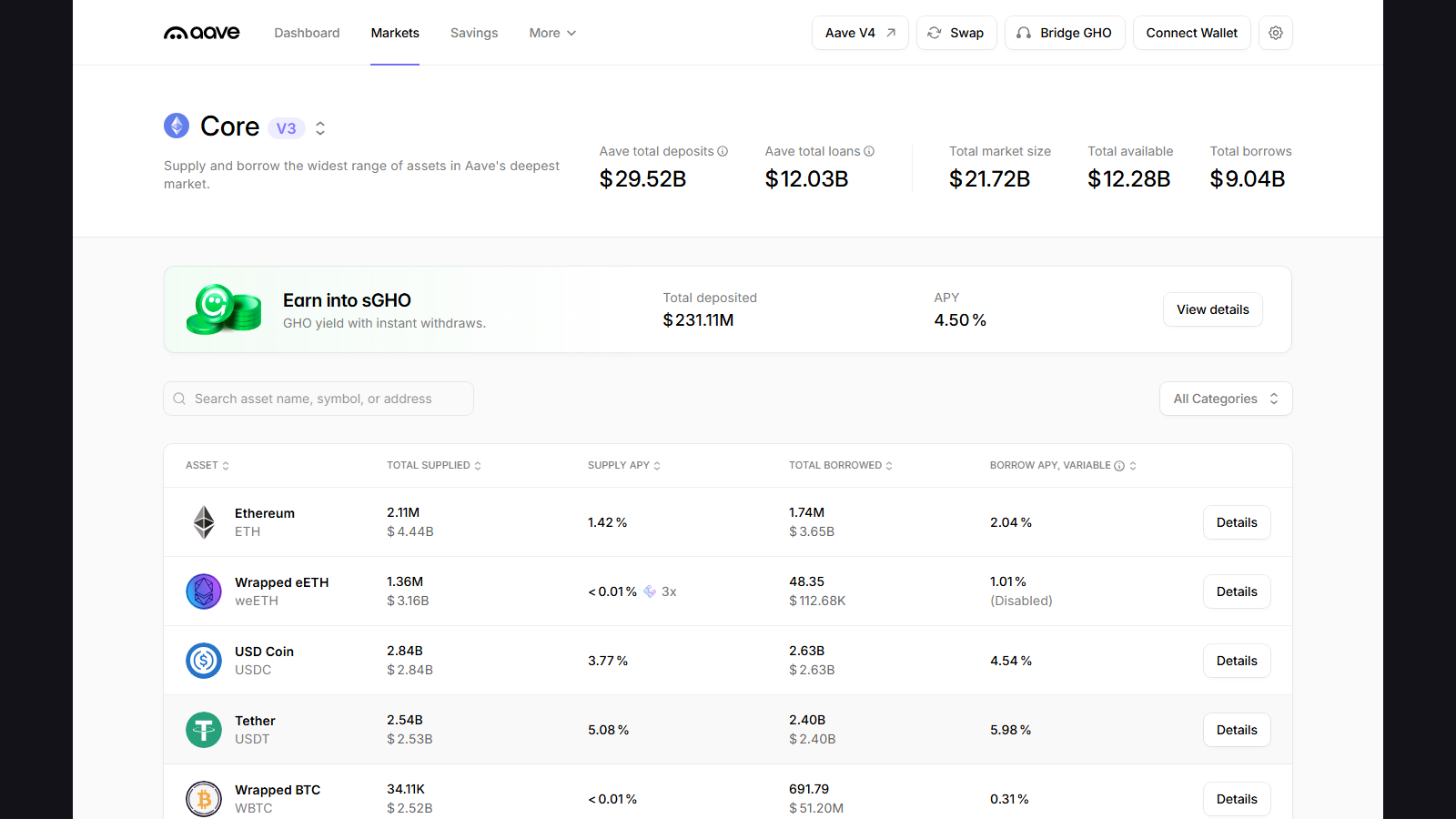
Aave V3 Core market on desktop. Total deposits read $29.52B at capture time, with sGHO advertised at 4.50% APY.
On the same page, USDC supply showed 3.77% and USDT 5.08% at capture, while ETH supply was 1.42%. Those numbers move all day, so treat them as a snapshot.
Aave’s own site claims more than $1T in cumulative loans and over half of decentralized lending. I could not verify those figures independently, so I list them as the project’s claim.
Aave V4 and the Aave Pro interface
Aave V4 went live on Ethereum on 30 March 2026 with a Hub and Spoke design: liquidity sits in Hubs, and Spokes define how it is used. The new interface is Aave Pro, which opens with an Earn view that groups assets by liquidity hub.
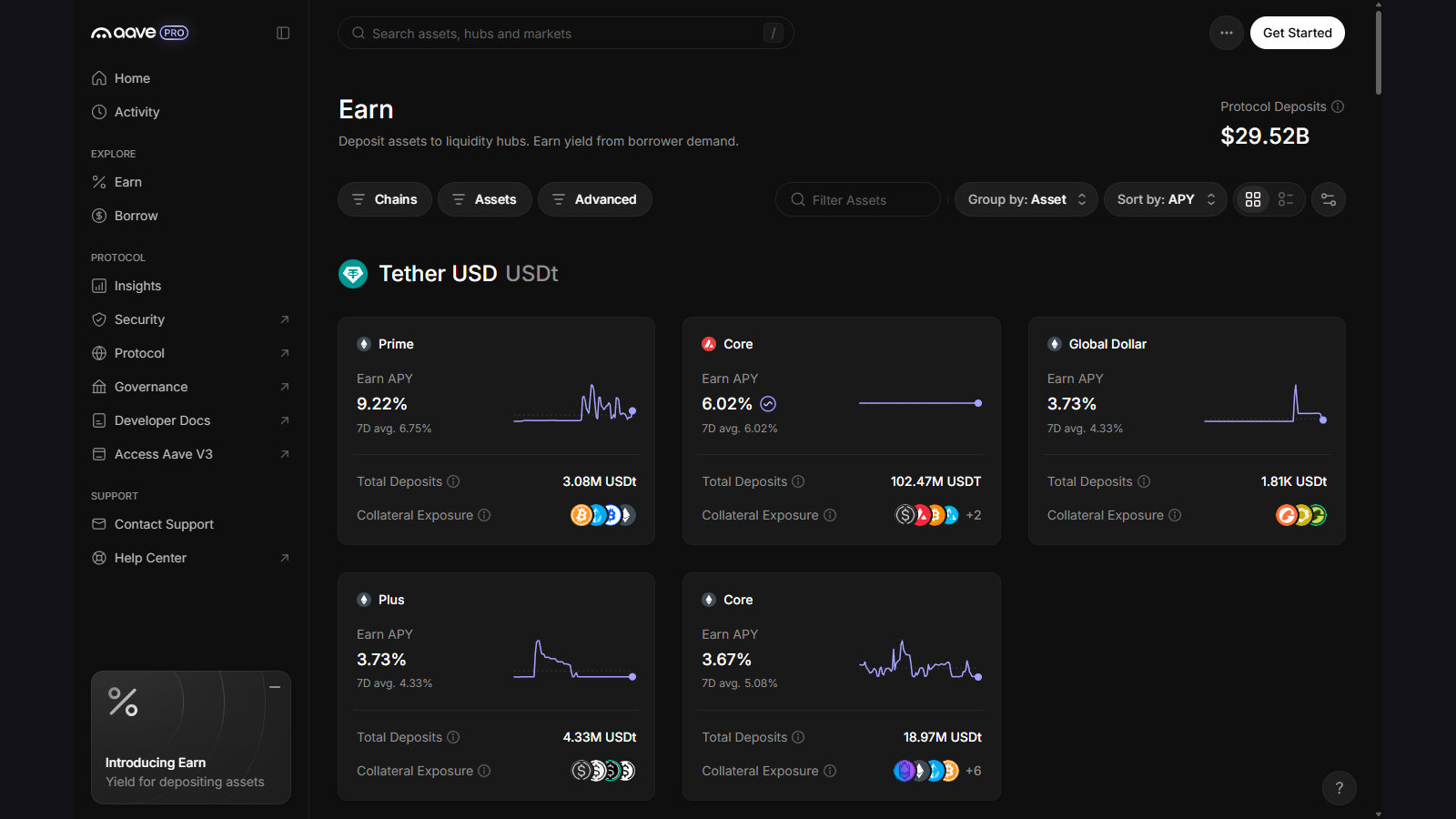
This is the biggest learning curve in 2026. The same asset can earn different rates depending on the hub, and the sidebar still links back to Aave V3 for people who want the older experience. If you are new, check which version you are on before you deposit.
Using Aave on desktop, tablet and phone
The V3 app is clean and table based. On desktop you get the top stats, the sGHO banner and a sortable asset list with Details buttons. On tablet the table turns into stacked cards, which is easier to read than a squeezed table.
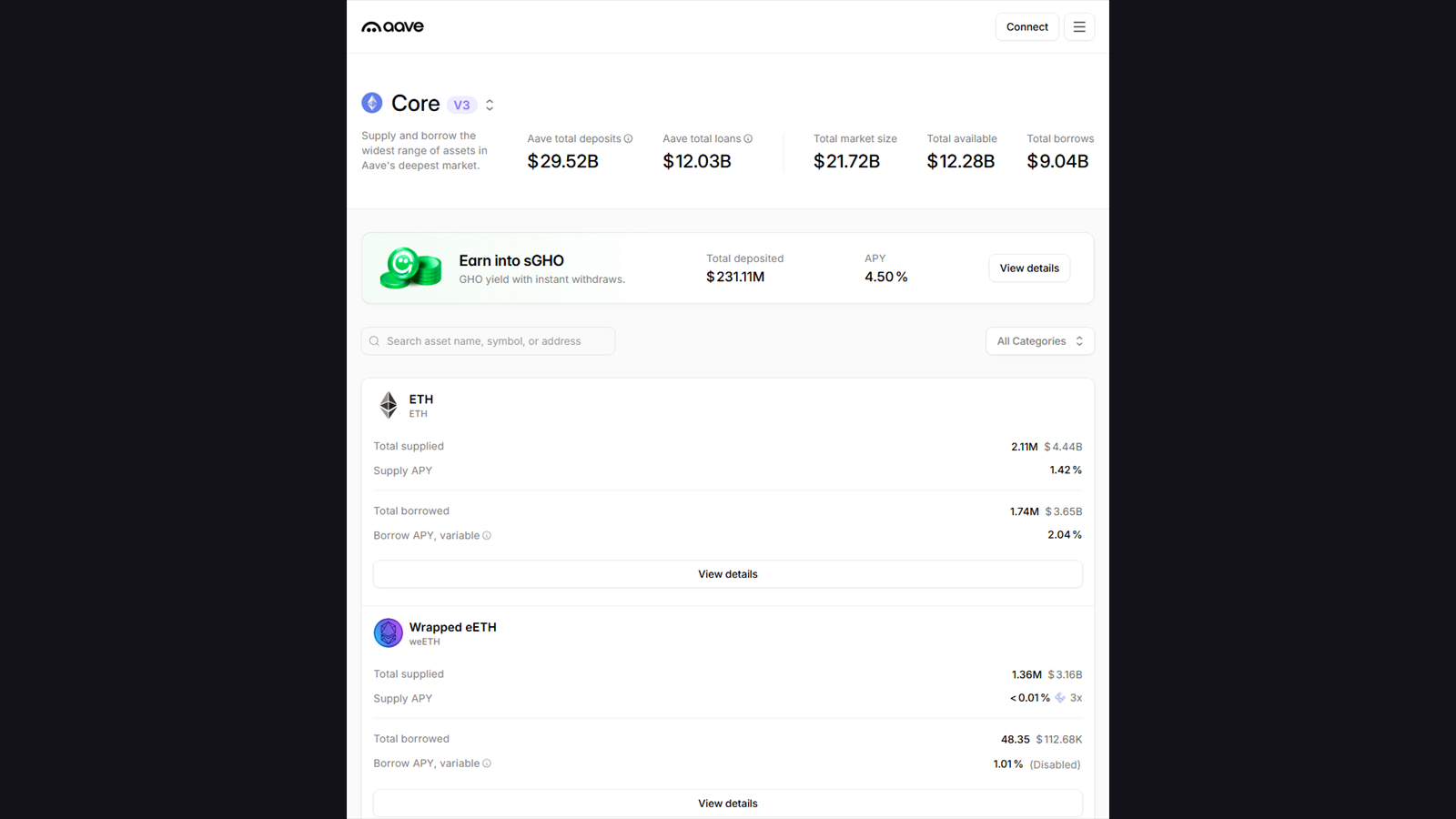
On phone the same cards fill the screen and the top nav collapses to a Connect button and a menu.
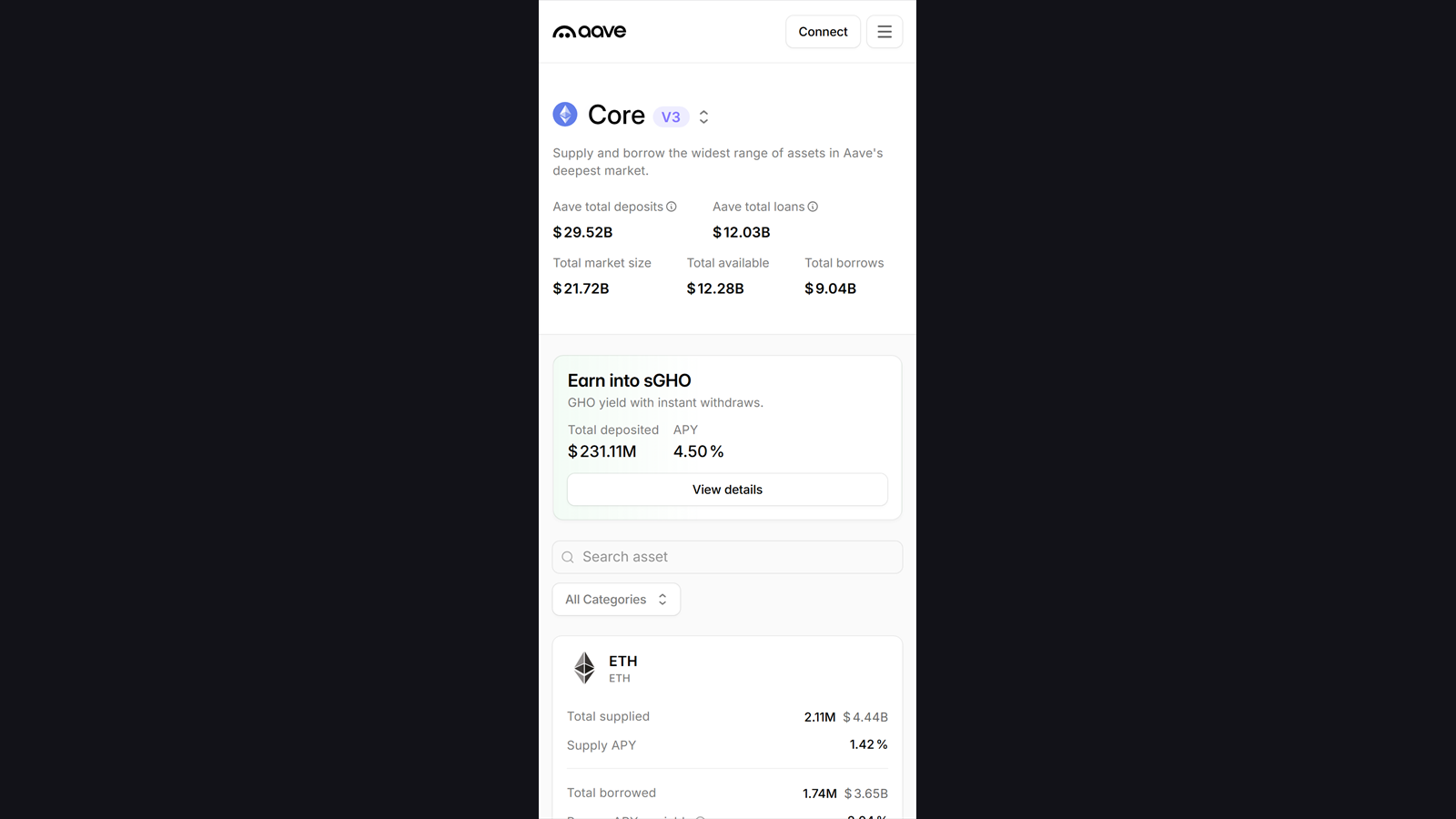
Best for: checking rates quickly on any device before moving funds.
Connecting a wallet
The Connect Wallet modal offers “Continue with Aave”, MetaMask, Coinbase Wallet and Other Wallets, plus an “I don’t have a wallet” link for beginners.
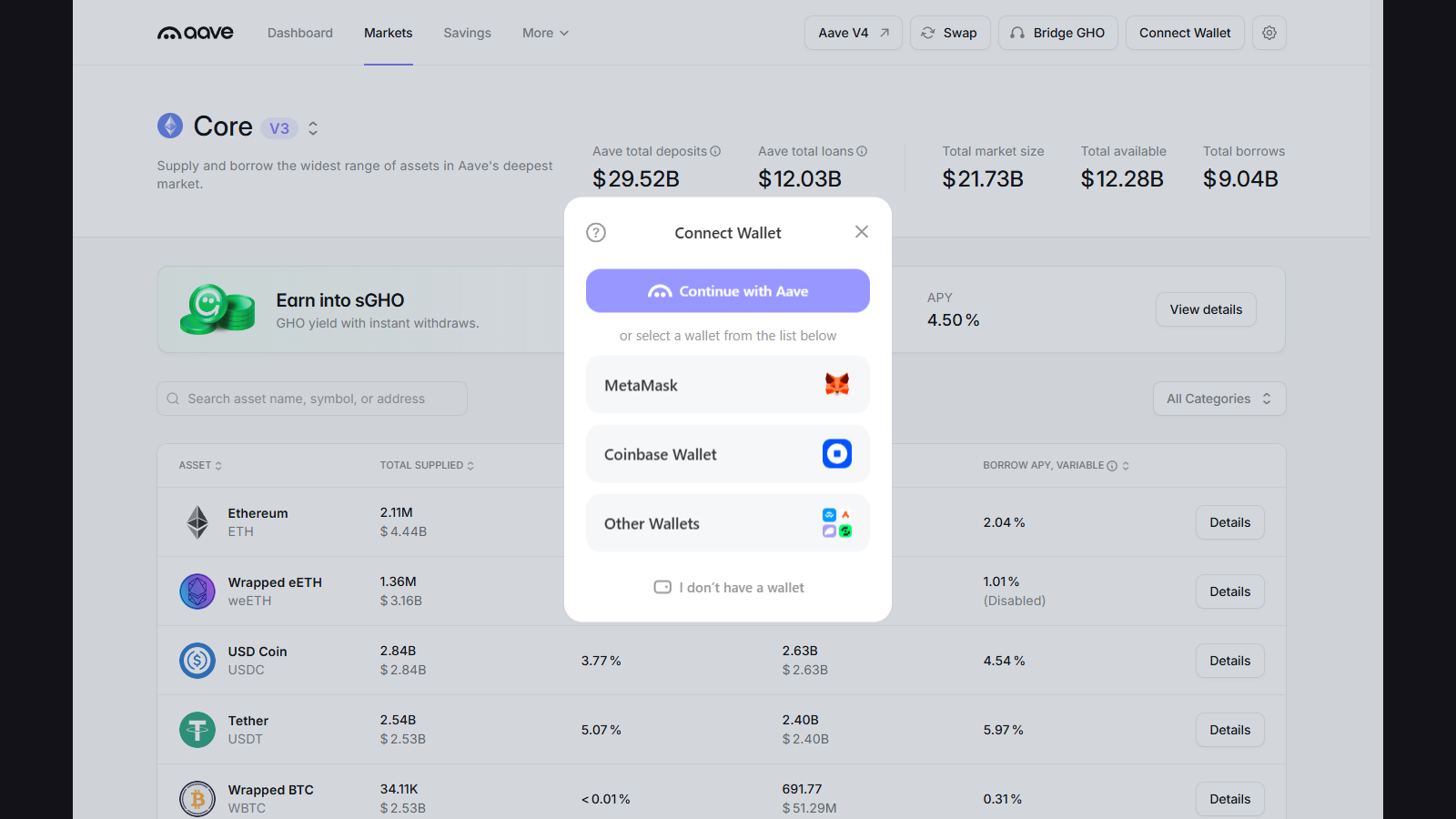
Clicking MetaMask first shows “Requesting Connection” inside Aave’s modal, and then a MetaMask window asks you to approve the site. In my run the window did not pop up on its own and I had to open the extension’s notification page manually to approve, so first-time users may need to open the MetaMask icon themselves.
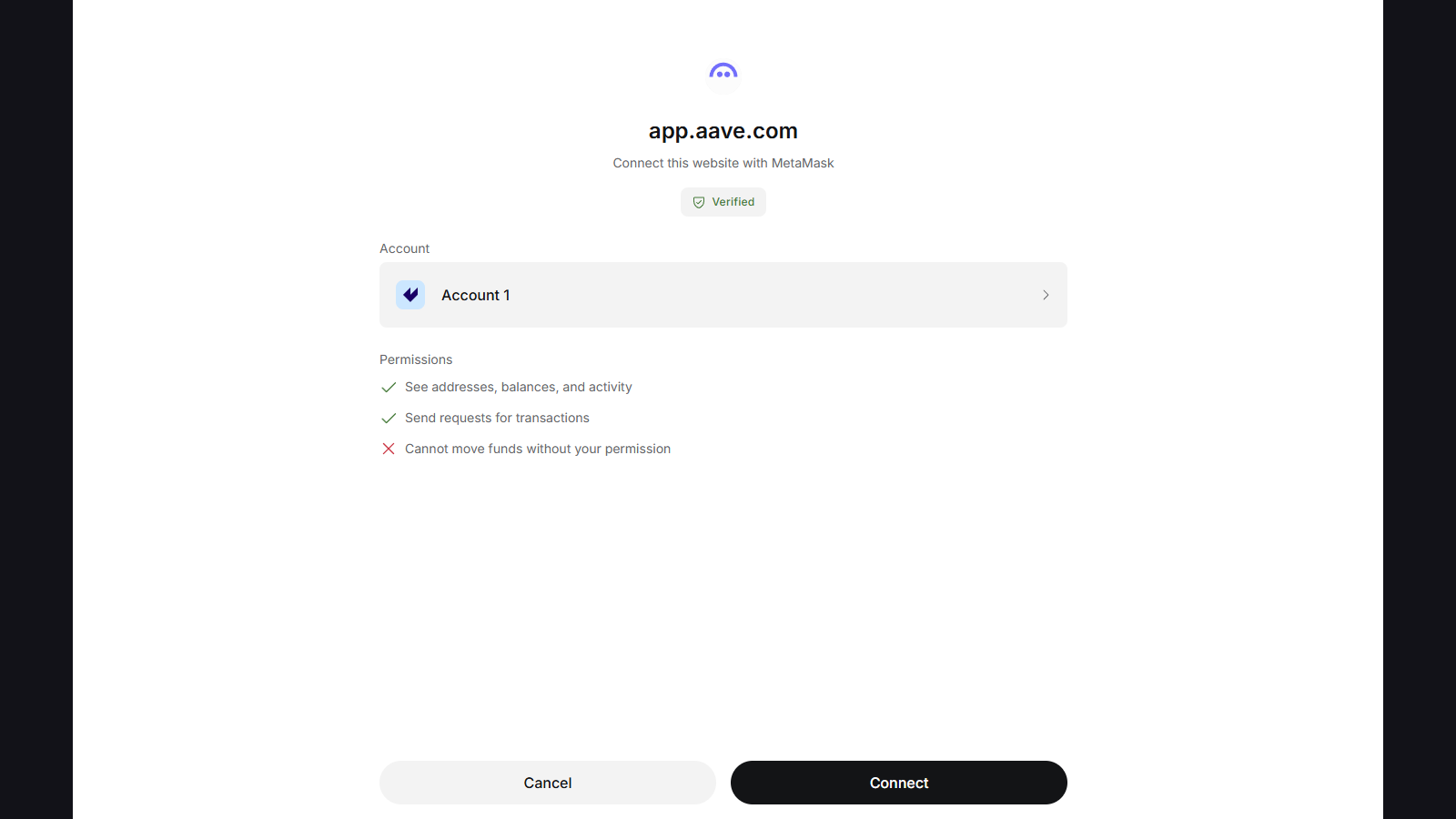
MetaMask asks to connect Account 1 to app.aave.com. It lists what the site can see and notes it cannot move funds without permission. After approval, the app switched to the Dashboard with my shortened address in the header.
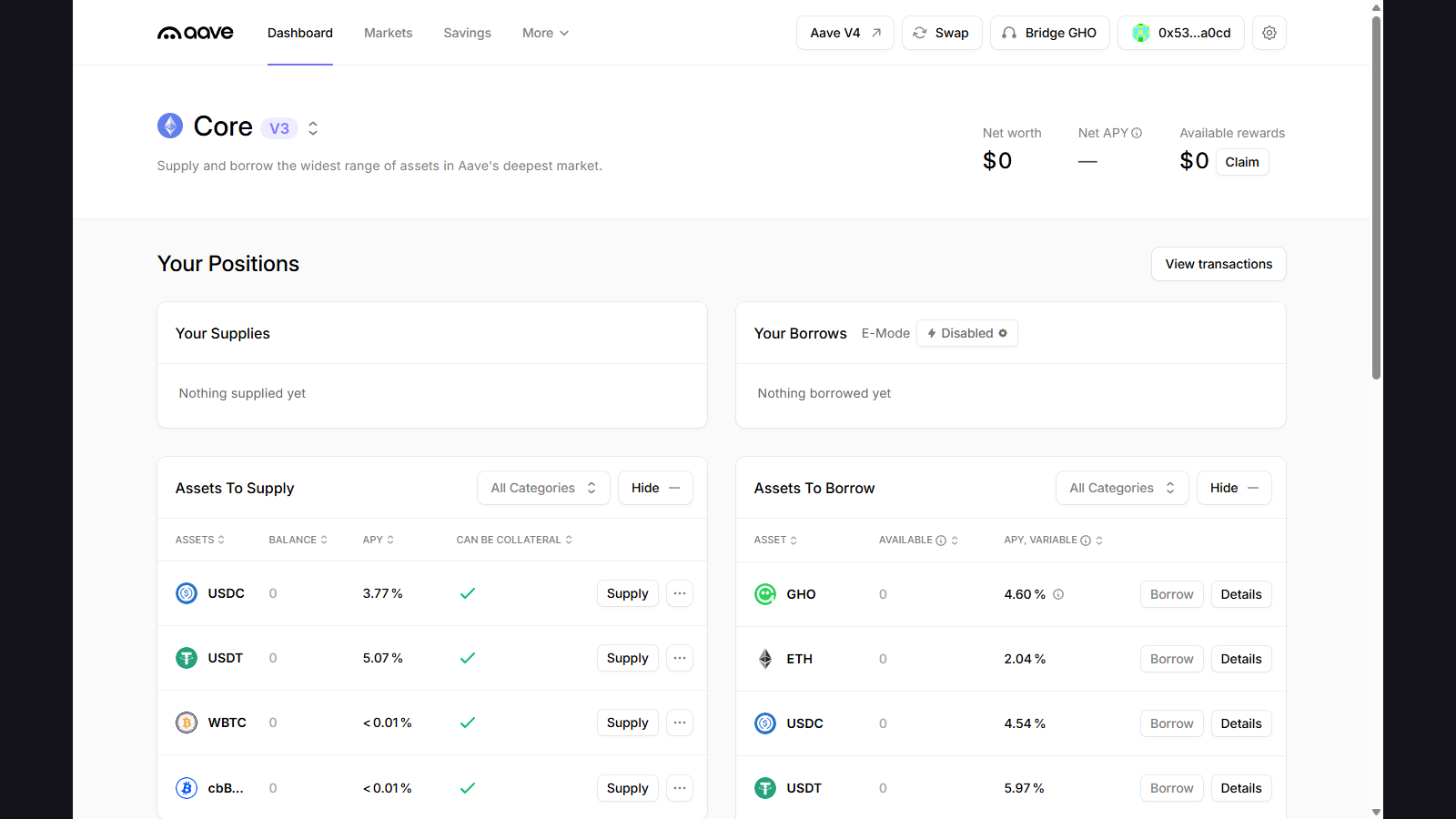
Connected dashboard with Net worth $0, empty supplies and borrows, and the Assets to Supply and Assets to Borrow lists. An empty wallet still lets you browse every asset and its current rate, which is a good way to learn before funding anything.
Fees and costs
Aave does not charge an account fee. Your cost as a borrower is the variable interest rate, and your cost as a supplier is the opportunity cost of lower rates than riskier venues. Every supply, borrow, repay or withdraw is an Ethereum transaction, so gas is the real friction on small deposits.
Flash loans carry their own fee. The V3 flash loan guide says it is set at 0.05% at deployment and can be changed by governance, while another page describes suppliers receiving a share tied to 0.09% of volume. I did not confirm which figure is live today, so check the docs if you build on flash loans.
Risks of borrowing and lending
Liquidation is the main risk. If your collateral value falls too far relative to your debt, liquidators can repay part of the loan and take collateral at a discount. Aave says it has processed more than $4.65B in liquidations, which shows the mechanism works at scale and also how often borrowers get caught.
Community threads reflect the same worries. In an r/defi thread about borrowing ETH against ETH, replies point out the position is mostly pointless and that the interest rate is the real risk. An r/defi thread on losing money lending stablecoins centres on depeg risk. I only read these threads for sentiment, not as proof.
Security and audits
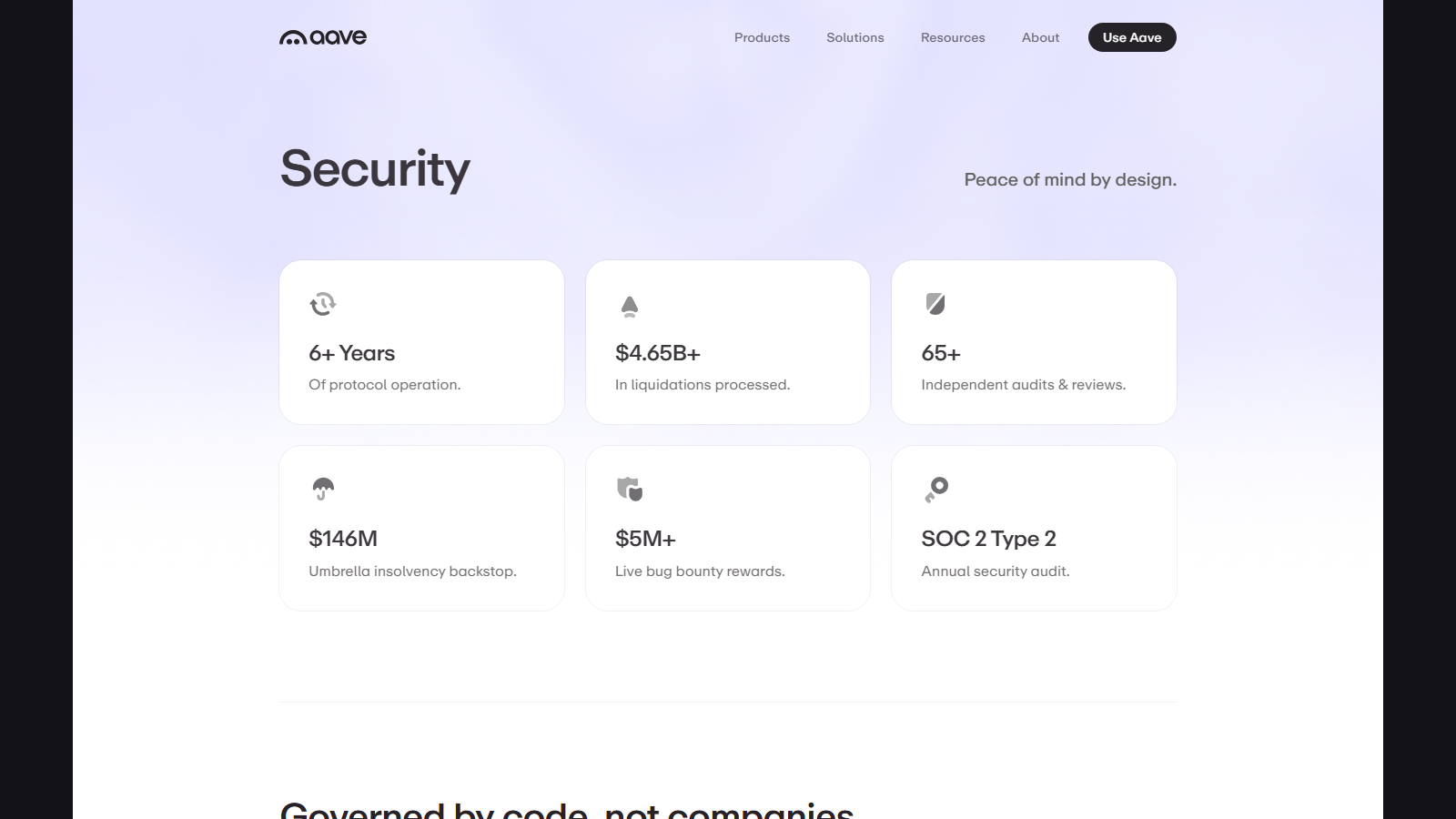
Aave’s security page lists 6+ years of operation, 65+ independent audits and reviews, a $146M Umbrella insolvency backstop, a bug bounty of $5M+ and an annual SOC 2 Type 2 audit.
Governance changes go through a timelock, and a 5-of-9 Guardian can cancel malicious proposals. That is more structure than most DeFi apps publish, but it is still smart contract software. Bugs, oracle failures and governance mistakes remain possible.
Who should use Aave
Good fit:
- Users who want to earn on stablecoins with a long-running protocol
- Borrowers who want a loan against crypto without selling it
- Developers who need deep liquidity and flash loans
Think twice:
- Anyone who cannot watch collateral ratios during volatile markets
- Small depositors on Ethereum mainnet where gas can eat the yield
- Beginners who have not checked whether they are on V3 or V4
FAQ
Is Aave safe?
It is non-custodial and heavily audited, but audits do not remove smart contract, oracle or liquidation risk. Start small and never borrow near the liquidation limit.
Does Aave charge fees?
There is no account fee. Borrowers pay variable interest and everyone pays network gas. Flash loans have a separate protocol fee set by governance.
Do I need an account?
No. You connect a wallet. I connected an empty MetaMask wallet and saw the full dashboard with no sign-up.
What is the difference between Aave V3 and V4?
V3 is the established pooled market at app.aave.com. V4 launched on 30 March 2026 with a Hub and Spoke design and the Aave Pro interface, where rates can differ by hub.
Disclaimer: This article is for informational purposes only and does not constitute financial or investment advice. Cryptocurrency and digital asset markets carry significant risk. Always do your own research before making decisions.
