



Curve Finance review examining stablecoin swaps, pool fees, crvUSD, LlamaLend, wallet usability, liquidity depth and lessons from past exploits.
Curve is the Ethereum exchange built around stablecoin swaps, and it has since grown a stablecoin (crvUSD) and a lending product (LlamaLend). This review covers what I could see and verify on 9 November 2026, and where the evidence stops.
Quick verdict: Curve is still the specialist for large stablecoin and like-for-like swaps, and its liquidity numbers are real. The interface is plain and sometimes confusing, the 2023 Vyper exploit is a reminder that compiler-level risk exists, and small swaps are not where Curve shines.
| Item | Detail |
|---|---|
| Best for | Large stablecoin swaps, stable LP, crvUSD borrowing |
| Fees | Low pool fees plus Ethereum gas, varies by pool |
| Custody | Non-custodial, you connect your own wallet |
| Audits | Per-contract audits listed in the docs, plus a past exploit to read about |
| Editorial score | 4.0 / 5 |
What I tested, and what I did not
I opened curve.finance on desktop (1440px), tablet (1024px) and phone (430px), looked at the swap page, the LlamaLend markets and the pools list, then connected a throwaway MetaMask wallet that holds no funds. I also read the developer documentation, the Halborn write-up of the 2023 Vyper exploit and several community threads. I did not execute a swap or deposit liquidity, so fee and slippage statements come from documentation and user reports, not my own trades.
What Curve actually is
According to the docs, Curve is a decentralized exchange and automated market maker on Ethereum and EVM sidechains and L2s, built for trading stablecoins and volatile assets efficiently. It also runs crvUSD, an overcollateralized stablecoin, and a lending product, both using a liquidation mechanism called LLAMMA.
The swap page is the front door. On Ethereum it showed about $1.17B in total deposits and $152.8M in daily volume at capture time.

Curve swap page on desktop. The orange banner is a standing reminder to check the domain, and the blue one announces that the old DEX dashboard has been retired in favour of the pools list. The top menu shows how big the product has become: DEX, LlamaLend, Governance, Bridge and Analytics.
Using Curve on tablet and phone
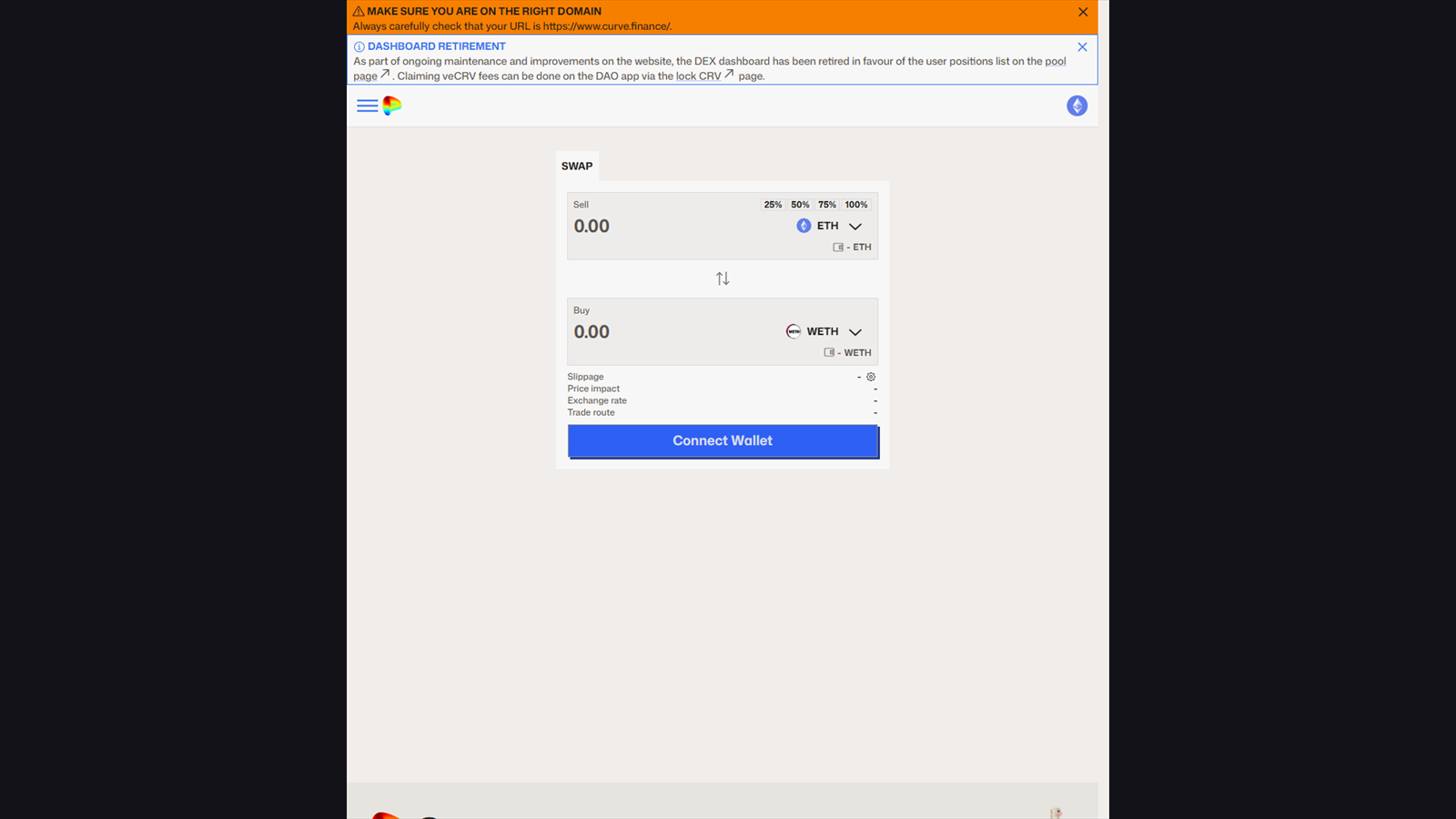
The page is functional on small screens but not polished. On tablet the menu collapses into a hamburger and the swap box stays centred, with quick 25%, 50%, 75% and 100% buttons added to the sell field.
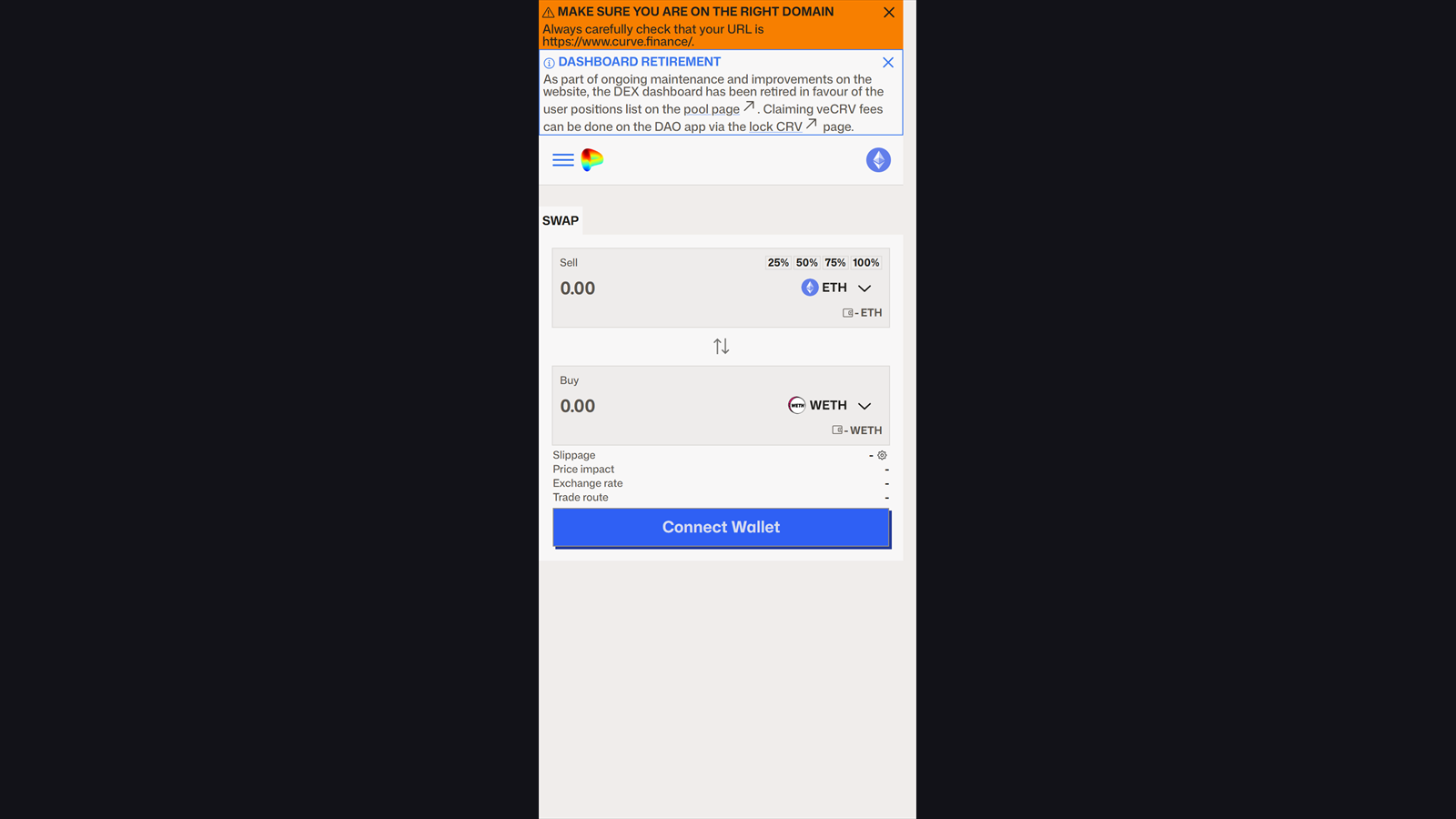
On phone the same layout stretches to full width, and the banners take up almost a third of the first screen.
Best for: desktop users who already know which pool or pair they want.
Connecting a wallet
The Connect Wallet button opens a short list: Browser Wallet, WalletConnect, MetaMask and Coinbase Wallet. No account, email or sign-up is involved.
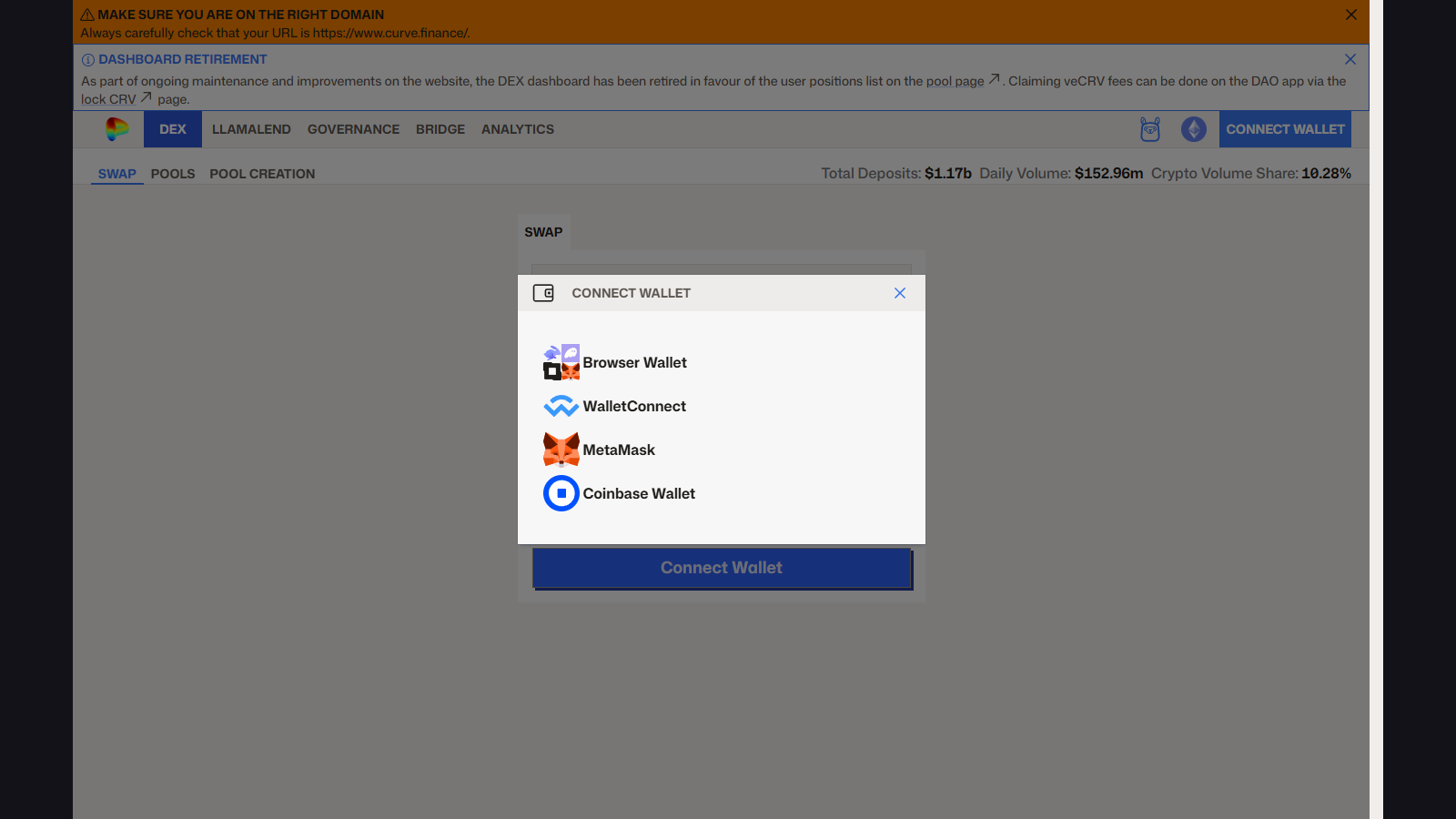
After I picked MetaMask, the extension did not open a window on its own, so I opened its notification page manually to approve. That may be a quirk of my automated browser, so I won’t claim it happens for everyone.
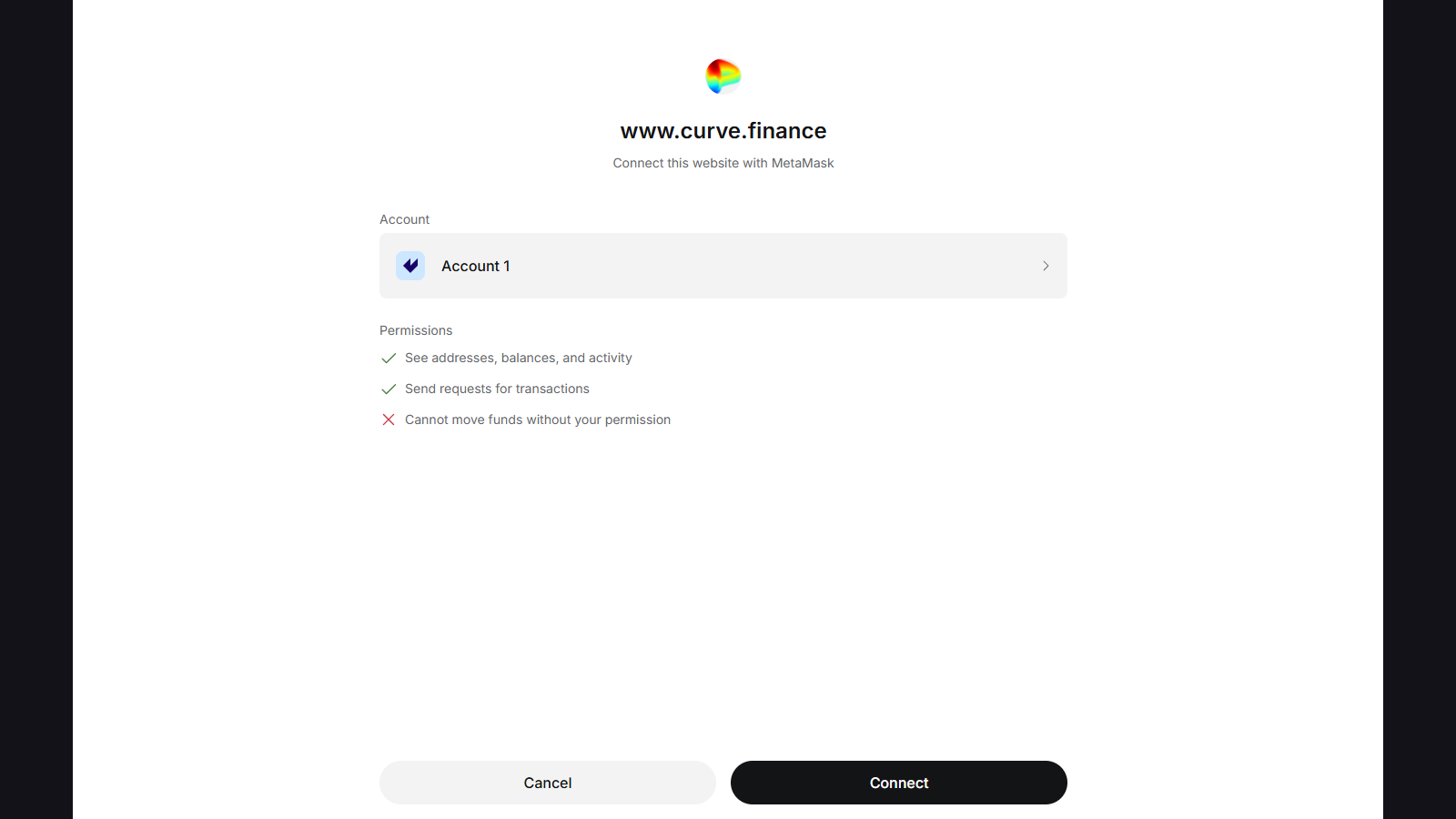
MetaMask asks to connect Account 1 to www.curve.finance, with a note that it cannot move funds without permission.
Once connected, the header shows my shortened address and the swap box shows 0 ETH and 0 WETH. It also reveals a two-step flow, “Approve spending” then “Swap”, with an estimated transaction cost line.
Connected swap page. The approve-then-swap sequence is visible, but both buttons are disabled because the wallet is empty.
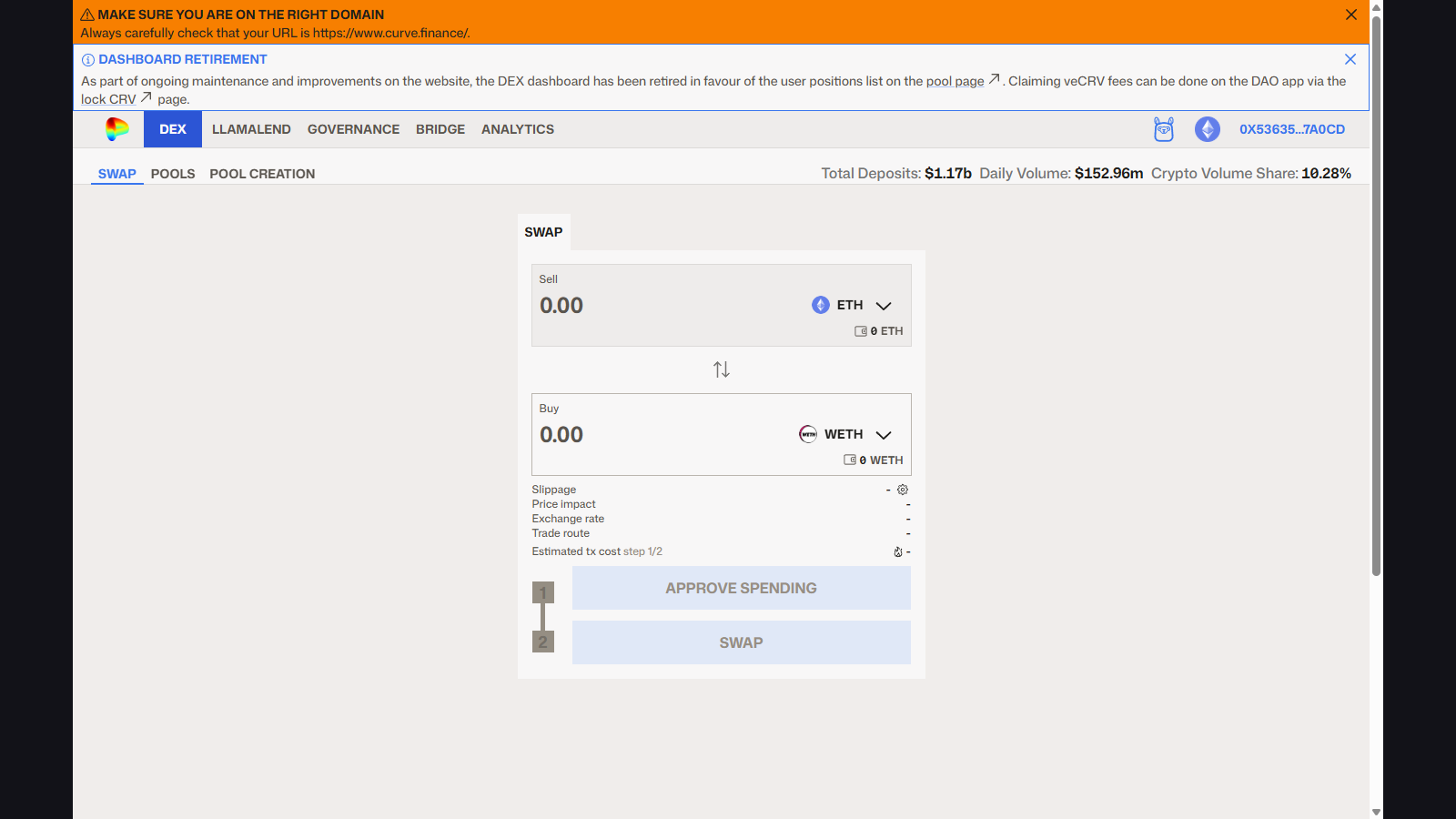
The two-step design means a token approval is a separate transaction. That is normal on Ethereum, but check the approval amount in your wallet before signing.
Pools and yields
The Pools tab shows your positions at the top and a searchable pool list below it, sorted by daily volume. At capture time the top rows were USDC/fxUSD with a 10.48% net APR, crvUSD/USDT at 18.58% and crvUSD/USDC at 3.46%, while the classic DAI/USDC/USDT pool held about $161.6M in TVL but showed a near-zero APR.

Those numbers include reward incentives in many cases and change all day. In an older r/defi thread asking why Curve is so popular with low returns, the poster points to modest APYs on most pools, which still matches the idea that Curve is about deep liquidity rather than high yield.
Fees and cost
Curve’s headline advantage is low swap fees on stable pairs. A recent r/productreview thread quotes stableswap fees in the 0.001% to 0.02% range, checked by the poster in July 2026. I did not verify that figure on-chain myself.
The same thread is useful on the practical side. One commenter says the fee advantage wins on large swaps while interface friction wins on small ones, and puts the break-even around $5,000. Treat that as a community rule of thumb, not a measurement. Gas on Ethereum can outweigh a tiny fee saving on small trades.
LlamaLend and crvUSD
LlamaLend lets you borrow crvUSD against collateral or lend assets. The markets page lists collateral and borrow pairs with borrow APR, supply APY, max leverage, utilisation, available liquidity and TVL.
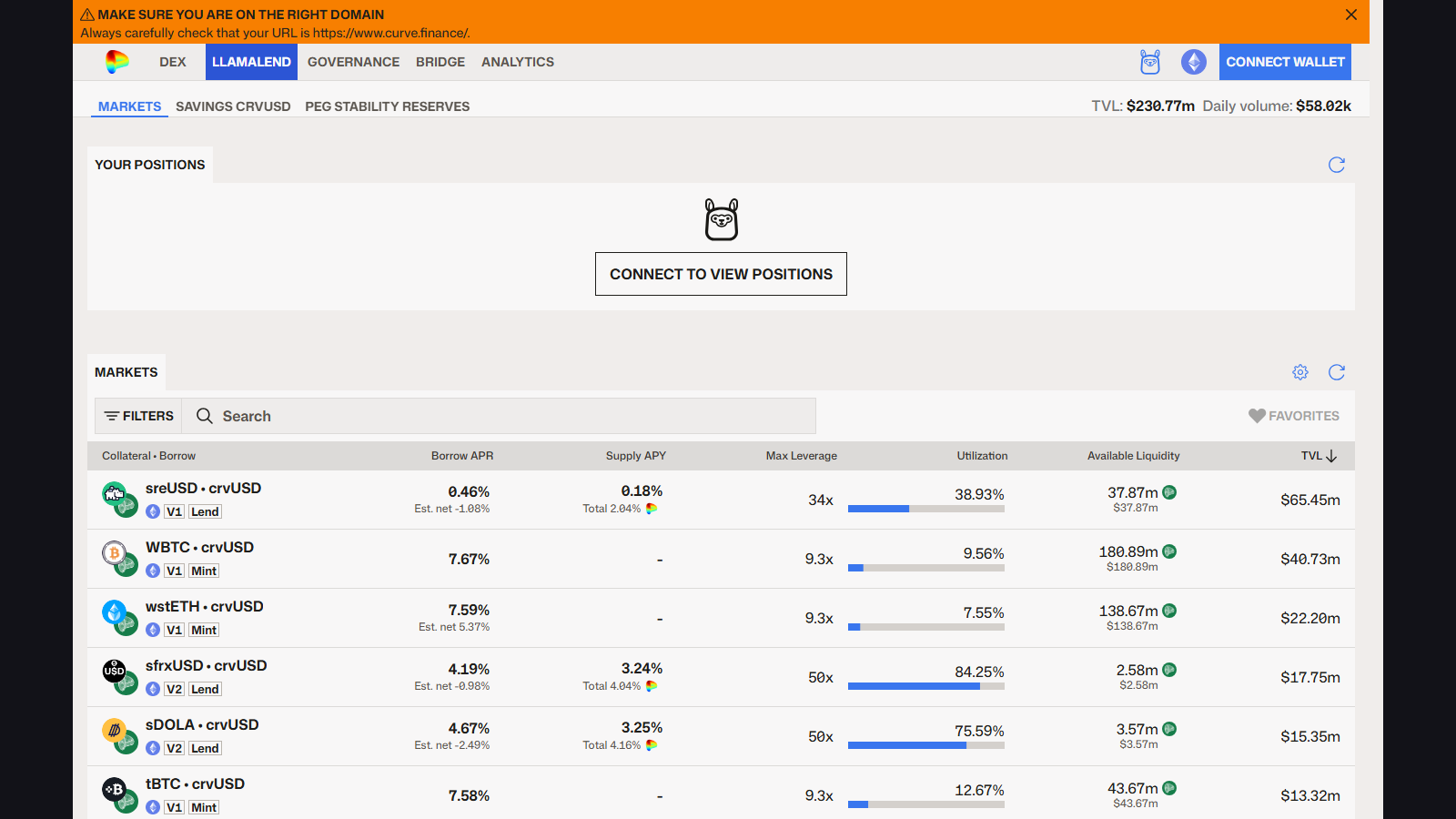
The docs now say LlamaLend v1 is being phased out with no new v1 markets, and that v2 should be used for new markets. Several rows still carry V1 labels, so check the version before you borrow.
Security and the 2023 exploit
In July 2023, attackers exploited a bug in certain Vyper compiler versions (0.2.15, 0.2.16 and 0.3.0) that affected reentrancy protection. Halborn estimates about $70M was stolen across several projects, falling to roughly $52M after whitehat intervention. Other outlets report different totals, such as about $62M from TechCrunch, so I would quote a range and not one number.
The lesson from that incident is that the risk sat in a compiler, not in Curve’s core stableswap math. A commenter in the r/productreview thread makes the same point. It is a good reminder that audits of contract code do not cover every layer. The developer docs also list a Security and Audits section, which I recommend reading before depositing size.
Who should use Curve
Good fit:
- People swapping stablecoins or similar assets in large size
- Liquidity providers who understand impermanent loss and incentives
- crvUSD users comfortable with soft liquidation mechanics
Think twice:
- Small traders where gas will exceed the fee saving
- Beginners who want a guided, polished interface
- Anyone depositing without reading the pool’s contract and audit details
FAQ
Is Curve Finance safe?
It is non-custodial and has run for years, but it suffered a major exploit in 2023 through a compiler bug. Use small amounts first and read the audit list.
Does Curve charge fees?
Pool fees are low on stable pairs according to community reports, and you also pay Ethereum gas. I did not run a swap to measure the final cost.
Do I need an account?
No. You connect a wallet. I connected an empty MetaMask wallet and could browse swaps, pools and LlamaLend markets.
Is Curve good for small swaps?
Probably not. Community users suggest it pays off at larger sizes, around several thousand dollars, because of gas and interface friction.
Disclaimer: This article is for informational purposes only and does not constitute financial or investment advice. Cryptocurrency and digital asset markets carry significant risk. Always do your own research before making decisions.
